Debian Popularity Screensaver
The Debian Popularity screensaver shows the packages Debian users actually have installed, from the opt-in Popularity Contest survey. The solid part of each bar is regular use, which is often a much smaller number than installs. It's free, runs in your browser, and ESC exits.
Live preview
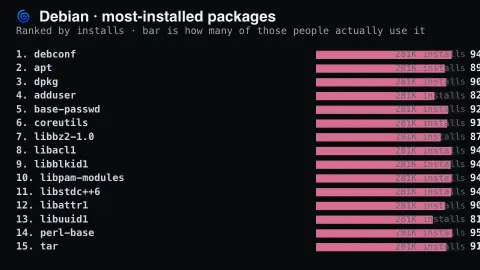
Press ESC to leave fullscreen. Settings are saved in your browser only.
How the Debian Popularity screensaver works
The background pipeline reads this from the Debian Popularity Contest and saves a snapshot the saver loads.
The packages Debian users actually have installed, from the opt-in Popularity Contest survey.
It refreshes on a schedule, so what you see stays current.
Colours can be changed in settings; nothing is stored beyond your own browser.
How popcon counts Debian packages
Debian's Popularity Contest is a small package, popularity-contest, that a user can choose to install. A cron job runs daily but submits a report only once a week. The report lists the installed packages along with the access and change times of the most recently used executable of each, and Debian publishes the anonymised, aggregated results at popcon.debian.org. Debian maintainers use the data to decide which packages to include by default.
The columns reflect two ideas. Installed (inst) counts systems that have the package. Vote, the regular-use figure, counts systems where the package's executable was accessed recently, judged from file access times, while old counts systems that have it installed but do not use it regularly. The gap between them is revealing: a library pulled in as a dependency can be installed almost everywhere, while a niche tool may sit untouched. Access times are only as reliable as the file system that records them.
Participation is optional, which skews the sample toward people who chose to enable it, so the numbers cannot be read as market share. They are best used as relative popularity among reporting Debian systems, and a package with no usable timestamps is counted separately as having no files.
A worked example
The packages Debian users actually have installed, from the opt-in Popularity Contest survey. The solid part of each bar is regular use, which is often a much smaller number than installs.
Settings & tips
- Accent and Background recolour the display.
- Run
automation/run.py debpopconto refresh the feed. - Press ESC to leave fullscreen.
Frequently asked questions
- Is this real data?
- Yes — it comes from the Debian Popularity Contest and is refreshed on a schedule.
- Is this the whole Debian install base?
- No. Popcon is opt-in, so the counts are survey responses from users who chose to report. The ranking is meaningful; the absolute numbers are not a census.
- Is a key needed?
- No. This source is fully key-less.
- Is it free?
- Yes — free, no download, in your browser.
- How does popcon decide whether a package is used?
- It looks at the access time of the package's most recently used executable. If that has not been touched recently, the package counts as installed but not regularly used.
- Why are some libraries at the top of the list?
- Many packages are installed as dependencies of others, so core components are present on almost every reporting system.
- How often do systems report?
- The package runs from cron every day but submits its results to Debian only once a week, and only on systems where the user installed it.