Structures Frozen Mid-Reaction Screensaver
The Structures Frozen Mid-Reaction screensaver shows newly deposited cryo-EM structures from EMBL-EBI's Electron Microscopy Data Bank, key-less. Cryo-EM won a Nobel Prize for letting biology see molecules that would never crystallise, and this is where the resulting maps land. It's free, runs in your browser, and ESC exits.
Live preview
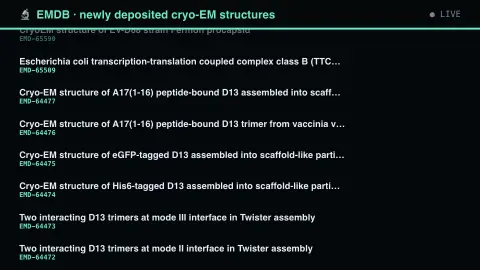
Press ESC to leave fullscreen. Settings are saved in your browser only.
How the Structures Frozen Mid-Reaction screensaver works
The saver reads the source described above and draws it on a canvas — no account, no tracking.
Newly deposited cryo-EM structures from EMBL-EBI's Electron Microscopy Data Bank, key-less. Cryo-EM won a Nobel Prize for letting biology see molecules that would never crystallise, and this is where the resulting maps land.
It refreshes on a schedule, so what you see stays current.
Colours can be changed in settings; nothing is stored beyond your own browser.
How cryo-EM maps are deposited
The Electron Microscopy Data Bank (EMDB) is a public repository for cryo-EM volumes and representative tomograms of macromolecular complexes and subcellular structures. It is run from EMBL-EBI and is a member of the worldwide Protein Data Bank (wwPDB), and entries are identified as EMD- followed by a number. Researchers freeze purified molecules in a thin layer of glassy ice, image many copies and combine the images computationally into a density map.
EMDB covers several methods: single-particle analysis, helical reconstruction, electron tomography, subtomogram averaging and electron crystallography. Each entry reports a resolution in ångströms (one ångström is a tenth of a nanometre), and smaller is sharper. At about 3 Å side chains are generally distinguishable, while lower-resolution maps show less detail.
The map is a grid of density values, not a finished molecular model. Where an atomic model has been built it is deposited in the Protein Data Bank through the joint deposition portal and cross-referenced. The release date is when an entry became public, which can be well after deposition: depositors may hold an entry until publication, but wwPDB policy limits this hold to one year from deposition, and entries are released weekly.
A worked example
Newly deposited cryo-EM structures from EMBL-EBI's Electron Microscopy Data Bank, key-less. Cryo-EM won a Nobel Prize for letting biology see molecules that would never crystallise, and this is where the resulting maps land.
Settings & tips
- Accent and Background recolour the display.
- Every value on screen comes from the live source — nothing is simulated.
- Press ESC to leave fullscreen.
Frequently asked questions
- Is this real data?
- Yes — it comes from the source named on this page and is refreshed on a schedule.
- Is a key needed?
- No. This source is fully key-less.
- Is it free?
- Yes, and it runs entirely in your browser.
- What does resolution in angstroms mean?
- It is a measure of how fine a detail the map can show. One angstrom is 0.1 nanometres, so lower numbers mean a sharper structure.
- Is every entry a protein?
- No. EMDB holds volumes of macromolecular complexes and subcellular structures, and the methods it covers include tomography as well as single-particle analysis.
- Why do entries sometimes appear long after the experiment?
- Depositors can ask for a hold until publication. wwPDB policy limits a hold to one year from deposition or until publication, whichever comes first.