Cosmic Ray Flux Screensaver
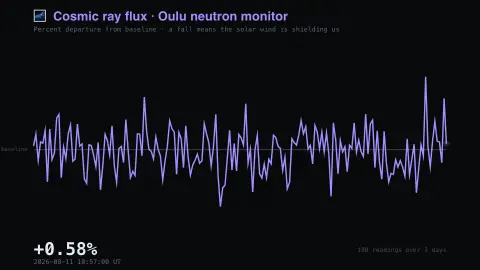
The Cosmic Ray Flux screensaver shows cosmic ray intensity measured at ground level by the Oulu neutron monitor, gathered key-less by the pipeline. The count runs inversely to solar activity, so a sudden fall usually means a coronal mass ejection swept past. It's free, runs in your browser, and ESC exits.
Live preview
Press ESC to leave fullscreen. Settings are saved in your browser only.
How the Cosmic Ray Flux screensaver works
The background pipeline reads this from the Oulu neutron monitor and saves a snapshot the saver loads.
Cosmic ray intensity measured at ground level by the Oulu neutron monitor, gathered key-less by the pipeline.
It refreshes on a schedule, so what you see stays current.
Colours can be changed in settings; nothing is stored beyond your own browser.
How a neutron monitor sees cosmic rays
Cosmic rays are high-energy charged particles that arrive from the Sun and from sources beyond the solar system. When they strike the atmosphere they trigger cascades of secondary particles, and some neutrons reach the ground. A neutron monitor is a ground-based detector that counts them, giving a continuous measure of cosmic ray intensity at its location. Oulu, run from the University of Oulu in Finland, is among the most stable long-running monitors, with a record since 1964.
The Neutron Monitor Database (NMDB) is a real-time database of high-resolution neutron monitor measurements from stations around the world, funded by the European Commission under its Seventh Framework Programme. It stores both uncorrected and pressure-corrected count rates, and corrected series are the ones normally analysed. Values are usually shown as a percentage change from a reference level, which is why they can be positive or negative.
The Sun's activity reduces the cosmic rays reaching Earth, so the count runs opposite to the 11-year sunspot cycle. A coronal mass ejection can sweep cosmic rays aside, producing a Forbush decrease: a drop over a few hours, with recovery over several days. Rare solar particle events strong enough to register at the ground, called ground level enhancements, do the opposite and briefly raise the count.
A worked example
Cosmic ray intensity measured at ground level by the Oulu neutron monitor, gathered key-less by the pipeline. The count runs inversely to solar activity, so a sudden fall usually means a coronal mass ejection swept past.
Settings & tips
- Accent and Background recolour the display.
- Run
automation/run.py nmdbto refresh the feed. - Press ESC to leave fullscreen.
Frequently asked questions
- Is this real data?
- Yes — it comes from the Oulu neutron monitor and is refreshed on a schedule.
- Why does the count fall when the Sun is active?
- A strong solar wind shields Earth from galactic cosmic rays, so ground-level counts drop. A sharp fall is usually a coronal mass ejection passing.
- Is a key needed?
- No. This source is fully key-less.
- Is it free?
- Yes — free, no download, in your browser.
- What is a Forbush decrease?
- It is a sudden drop in galactic cosmic ray intensity at Earth that follows a coronal mass ejection. The drop happens over a few hours and recovery takes several days.
- Why can the value be negative?
- The data are shown as a percentage change from a reference level. A negative number means the count is below that level.
- Can the count go up as well as down?
- Yes. Ground level enhancements are solar particle events strong enough to raise radiation at the surface, and they occur roughly 10 to 15 times per decade.