Variants Called Pathogenic Screensaver
The Variants Called Pathogenic screensaver shows clinVar variant interpretations counted by classification, key-less from NCBI. ClinVar is where laboratories deposit their reading of a genetic variant: this change, in this gene, means this for a patient. The count of uncertain-significance records against confident ones is the honest state of clinical genetics, and a meaningful fraction are later reclassified as evidence improves. It's free, runs in your browser, and ESC exits.
Live preview
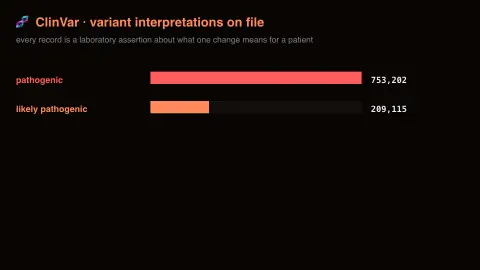
Press ESC to leave fullscreen. Settings are saved in your browser only.
How the Variants Called Pathogenic screensaver works
The saver reads the source described above and draws it on a canvas — no account, no tracking.
ClinVar variant interpretations counted by classification, key-less from NCBI. ClinVar is where laboratories deposit their reading of a genetic variant: this change, in this gene, means this for a patient. The count of uncertain-significance records against confident ones is the honest state of clinical genetics, and a meaningful fraction are later reclassified as evidence improves.
It refreshes on a schedule, so what you see stays current.
Colours can be changed in settings; nothing is stored beyond your own browser.
ClinVar and the five tiers of variant classification
ClinVar is a public archive hosted by the National Center for Biotechnology Information at the US National Library of Medicine, part of the National Institutes of Health. Laboratories, research groups and recognised expert panels submit their interpretation of a genetic variant, a specific change in DNA, along with supporting evidence. ClinVar does not decide the answer; it reports what submitters conclude and states plainly where they agree and where they conflict.
Most submitters use the five-tier scheme from the 2015 joint standards of the American College of Medical Genetics and Genomics and the Association for Molecular Pathology: pathogenic, likely pathogenic, uncertain significance, likely benign and benign. Uncertain significance is the default when evidence is too thin or conflicting to say more. Each record also carries a review status that indicates how much trust its classification deserves, and classifications from recognised expert panels are archived too.
Classifications are not permanent. Submitters can update their records, ClinVar keeps the earlier versions, and it changes a classification only when a submitter supplies new data. The counts you see are assertions deposited in an archive, not diagnoses, and they cannot tell any individual what a variant means for their health, which is a question for a clinician or genetic counsellor.
A worked example
ClinVar variant interpretations counted by classification, key-less from NCBI. ClinVar is where laboratories deposit their reading of a genetic variant: this change, in this gene, means this for a patient. The count of uncertain-significance records against confident ones is the honest state of clinical genetics, and a meaningful fraction are later reclassified as evidence improves.
Settings & tips
- Accent and Background recolour the display.
- Every value on screen comes from the live source — nothing is simulated.
- Press ESC to leave fullscreen.
Frequently asked questions
- Is this real data?
- Yes — it comes from the source named on this page and is refreshed on a schedule.
- Is a key needed?
- No. This source is fully key-less.
- Is it free?
- Yes, and it runs entirely in your browser.
- What does variant of uncertain significance mean?
- It means the available evidence is not enough, or is conflicting, so the variant is not classified as either harmful or harmless. It is the default category when the classification criteria are not met.
- Can a classification change?
- Yes. Submitters can update their records, and ClinVar keeps the previous versions so the history can be reviewed. ClinVar itself changes a classification only when a submitter provides new data.
- Is this useful for diagnosing myself?
- No. The counts are submitted interpretations, not diagnoses. What a variant means for a person depends on their clinical picture and should be discussed with a qualified professional.