Brazil’s Policy Rate Screensaver
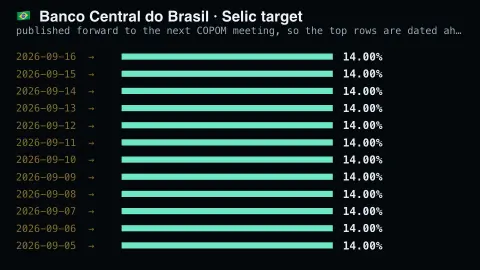
The Brazil’s Policy Rate screensaver shows the Selic target from the Banco Central do Brasil, key-less. Rows dated ahead of today are not a forecast or an error: the bank sets the rate until the next COPOM meeting. Dates arrive DD/MM/YYYY and are reordered rather than handed to Date(). It's free, runs in your browser, and ESC exits.
Live preview
Press ESC to leave fullscreen. Settings are saved in your browser only.
How the Brazil’s Policy Rate screensaver works
The saver reads the source described above and draws it on a canvas — no account, no tracking.
The Selic target from the Banco Central do Brasil, key-less. Rows dated ahead of today are not a forecast or an error: the bank sets the rate until the next COPOM meeting. Dates arrive DD/MM/YYYY and are reordered rather than handed to Date().
It refreshes on a schedule, so what you see stays current.
Colours and any options can be changed in settings; nothing is stored beyond your own browser.
What the Selic target actually is
Selic is short for Sistema Especial de Liquidação e de Custódia, the system for settlement and custody of federal government securities, which the central bank manages. The name has come to stand for the benchmark rate: the average rate on overnight interbank operations backed by federal government securities. The Banco Central do Brasil sets a target for it, and open market operations keep the daily effective rate close to that target.
The target is decided by the central bank’s Monetary Policy Committee, known as Copom, in two-day meetings held on a calendar published in advance. Between meetings the target does not move, so the series looks like a staircase: flat stretches with a step at each decision that changes it. The rate is quoted as a percentage per year.
The series is the policy target, not what ordinary borrowers pay; bank loans, credit cards and mortgages are priced by lenders on top of the benchmark. Rows dated ahead of today are the rate still in force, not a forecast.
A worked example
The Selic target from the Banco Central do Brasil, key-less. Rows dated ahead of today are not a forecast or an error: the bank sets the rate until the next COPOM meeting. Dates arrive DD/MM/YYYY and are reordered rather than handed to Date().
Settings & tips
- Accent and Background recolour the display.
- Every value on screen comes from the live source — nothing is simulated.
- Press ESC to leave fullscreen.
Frequently asked questions
- Is this real data?
- Yes — it comes from the source named on this page and is refreshed on a schedule.
- Is a key needed?
- No. This source is fully key-less.
- Is it free?
- Yes, and it runs entirely in your browser.
- How often does the Selic target change?
- Only at Copom meetings, which follow a calendar published in advance, and Copom can also hold the target unchanged. In between, the same value carries forward.
- Is the Selic the rate consumers pay?
- No. It is the overnight interbank benchmark, based on operations backed by government securities. Retail loan and card rates are set by lenders and sit on top of it.