The Chemistry of Being Alive Screensaver
The The Chemistry of Being Alive screensaver shows biochemical reactions from Rhea, EMBL-EBI's curated reaction database, key-less. Drawn as equations rather than names because the equation is the fact. Sampled from a random window: Rhea id order is an artefact of curation batches, not chronology. It's free, runs in your browser, and ESC exits.
Live preview
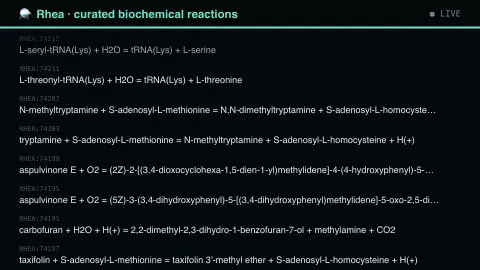
Press ESC to leave fullscreen. Settings are saved in your browser only.
How the The Chemistry of Being Alive screensaver works
The saver reads the source described above and draws it on a canvas — no account, no tracking.
Biochemical reactions from Rhea, EMBL-EBI's curated reaction database, key-less. Drawn as equations rather than names because the equation is the fact. Sampled from a random window: Rhea id order is an artefact of curation batches, not chronology.
It refreshes on a schedule, so what you see stays current.
Colours and any options can be changed in settings; nothing is stored beyond your own browser.
What Rhea curates
Rhea is an expert-curated knowledgebase of biochemical reactions, developed by the SIB Swiss Institute of Bioinformatics with contributors that include EMBL-EBI, and it is the standard for annotating enzyme reactions in UniProtKB. Reactions are curated manually from the peer-reviewed literature. Each one is written as an equation whose participants are entities from the ChEBI chemical ontology, and curators check that mass and charge balance on both sides.
That is why the saver draws equations rather than descriptions. Rhea represents each reaction as an undirected master reaction plus directional forms that fix a direction, and many reactions link to an enzyme classification (EC) number, which sorts enzymes by the reaction they catalyse. Compounds are recorded as the major microspecies at pH 7.3, so protonation states follow that convention, and the entries range from familiar ones like ATP and water to obscure lipids and cofactors.
Presence in Rhea means a reaction is documented in the literature. It does not say how common or fast the reaction is in any particular cell, and the list is a catalogue of known biochemistry rather than a ranking of importance.
A worked example
Biochemical reactions from Rhea, EMBL-EBI's curated reaction database, key-less. Drawn as equations rather than names because the equation is the fact. Sampled from a random window: Rhea id order is an artefact of curation batches, not chronology.
Settings & tips
- Accent and Background recolour the display.
- Every value on screen comes from the live source — nothing is simulated.
- Press ESC to leave fullscreen.
Frequently asked questions
- Is this real data?
- Yes — it comes from the source named on this page and is refreshed on a schedule.
- Is a key needed?
- No. This source is fully key-less.
- Is it free?
- Yes, and it runs entirely in your browser.
- Why are the equations so detailed?
- Rhea balances mass and charge, so hydrogen ions, water and cofactors are shown explicitly. Textbook summaries often leave these out.
- What is an EC number?
- A classification code for enzymes based on the reaction they catalyse. Many Rhea reactions are linked to one, though the link is optional because some reactions have no EC classification.
- Does every reaction happen in humans?
- No. Rhea is not limited to human metabolism and also covers enzymatic, transport and spontaneous reactions from across biology.