Aviation Hazards Screensaver
The Aviation Hazards screensaver shows sIGMETs and AIRMETs in force right now — turbulence, icing, volcanic ash and convective weather — gathered key-less by the pipeline. Informational only, and not a flight planning tool. It's free, runs in your browser, and ESC exits.
Live preview
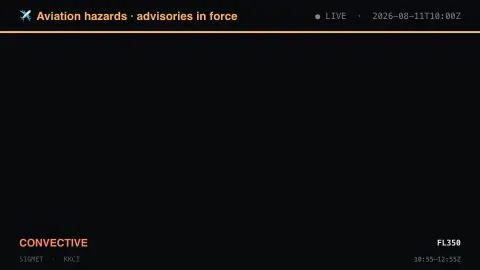
Press ESC to leave fullscreen. Settings are saved in your browser only.
How the Aviation Hazards screensaver works
The background pipeline reads this from the NOAA Aviation Weather Center and saves a snapshot the saver loads.
SIGMETs and AIRMETs in force right now — turbulence, icing, volcanic ash and convective weather — gathered key-less by the pipeline.
It refreshes on a schedule, so what you see stays current.
Colours can be changed in settings; nothing is stored beyond your own browser.
SIGMETs, AIRMETs and what they warn about
A SIGMET, short for Significant Meteorological Information, is an advisory warning aircraft of hazardous weather such as severe turbulence, severe icing, dust storms and volcanic ash. In the United States, a Convective SIGMET covers significant thunderstorm activity and is valid for two hours, which is why those entries have short lifespans. Other SIGMETs run longer, up to a few hours depending on the hazard.
An AIRMET sits one tier below. It describes en route weather that may affect the safety of aircraft but falls short of SIGMET intensity: moderate turbulence, sustained surface winds of 30 knots or more, moderate icing, reduced visibility and mountain obscuration. These matter most to light aircraft and flights at lower altitudes. Where the two overlap in topic, the difference is mainly severity.
The data comes from the NOAA Aviation Weather Center, which publishes these advisories for the airspace it is responsible for, not the whole world. The list changes through the day as storms form and decay and as advisories expire. It is a window into the advisories, not an aviation briefing, and should never be used to plan or fly a flight.
A worked example
SIGMETs and AIRMETs in force right now — turbulence, icing, volcanic ash and convective weather — gathered key-less by the pipeline. Informational only, and not a flight planning tool.
Settings & tips
- Accent and Background recolour the display.
- Run
automation/run.py sigmetsto refresh the feed. - Press ESC to leave fullscreen.
Frequently asked questions
- Is this real data?
- Yes — it comes from the NOAA Aviation Weather Center and is refreshed on a schedule.
- Can I use this for flight planning?
- No. It is informational only. Real flight planning uses official briefing sources, and this shows a subset of advisories without the full text or geometry.
- Is a key needed?
- No. This source is fully key-less.
- Is it free?
- Yes — free, no download, in your browser.
- What is the difference between a SIGMET and an AIRMET?
- A SIGMET warns of hazards significant to all aircraft, such as severe turbulence, severe icing or volcanic ash. An AIRMET covers less severe conditions, such as moderate turbulence or icing, that matter mostly to smaller aircraft.
- Why do advisories vanish so quickly?
- Each advisory is issued for a limited validity period. A Convective SIGMET lasts two hours, and it is replaced by a new one if the thunderstorms persist.