What Arch Users Install Screensaver
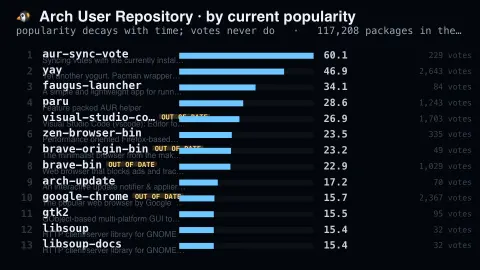
The What Arch Users Install screensaver shows the head of the Arch User Repository, gathered key-less by the pipeline. The AUR publishes two popularity numbers and they disagree: votes never decay, popularity does. Dropbox out-votes VS Code and has a twentieth of its popularity. It's free, runs in your browser, and ESC exits.
Live preview
Press ESC to leave fullscreen. Settings are saved in your browser only.
How the What Arch Users Install screensaver works
The saver reads the source described above and draws it on a canvas — no account, no tracking.
The head of the Arch User Repository, gathered key-less by the pipeline. The AUR publishes two popularity numbers and they disagree: votes never decay, popularity does. Dropbox out-votes VS Code and has a twentieth of its popularity.
It refreshes on a schedule, so what you see stays current.
Colours and any options can be changed in settings; nothing is stored beyond your own browser.
How the Arch User Repository works
Arch Linux ships a deliberately small set of official packages, and the Arch User Repository is a community-driven repository that fills the gaps. It holds PKGBUILD scripts, which makepkg runs to download source code and build a package that pacman can install; it does not hold prebuilt binaries. Users can build manually or use an unofficial AUR helper such as yay or paru. Typical contents include software that cannot be redistributed directly, development or beta variants, and niche programs.
Each package has a vote count and a popularity score. Votes come from users who vote for a package and, as the saver's description notes, they never decay, while popularity does, so a package loved years ago and unused today slides down while a recently adopted one climbs. The AUR also marks packages as orphaned when they have no maintainer.
The saver shows the top end of the repository. High scores mean many Arch users want a package, not that it has been audited: anyone can upload a recipe, no trusted person validates every script, and Arch directs users to review a PKGBUILD before building it. Package Maintainers, who are official Arch staff, look after popular packages and screen PKGBUILDs for malware.
A worked example
The head of the Arch User Repository, gathered key-less by the pipeline. The AUR publishes two popularity numbers and they disagree: votes never decay, popularity does. Dropbox out-votes VS Code and has a twentieth of its popularity.
Settings & tips
- Accent and Background recolour the display.
- Every value on screen comes from the live source — nothing is simulated.
- Press ESC to leave fullscreen.
Frequently asked questions
- Is this real data?
- Yes — it comes from the source named on this page and is refreshed on a schedule.
- Is a key needed?
- No. This source is fully key-less.
- Is it free?
- Yes, and it runs entirely in your browser.
- What is an orphaned package?
- One with no current maintainer. Until someone adopts it, fixes and updates depend on volunteers stepping in.
- Why do votes and popularity differ so much?
- Votes never decay, while popularity does. A long-standing package can have many votes and a low popularity score.
- Is it safe to install the top packages?
- The AUR is not vetted package by package, so users are expected to read each build script before building. Popularity is a signal of use, not of review.