Who Owns The Literature Screensaver
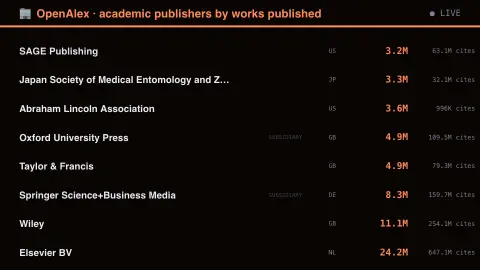
The Who Owns The Literature screensaver shows academic publishers by works published, key-less from OpenAlex. Elsevier alone carries more works than the next two together, which is the single fact behind most arguments about journal pricing. A hierarchy level above zero means the publisher is itself owned by another one on the list. These figures were sanity-checked against known catalogue sizes first — OpenAlex's sources endpoint is visibly corrupted, so its numbers cannot be taken on trust. It's free, runs in your browser, and ESC exits.
Live preview
Press ESC to leave fullscreen. Settings are saved in your browser only.
How the Who Owns The Literature screensaver works
The saver reads the source described above and draws it on a canvas — no account, no tracking.
Academic publishers by works published, key-less from OpenAlex. Elsevier alone carries more works than the next two together, which is the single fact behind most arguments about journal pricing. A hierarchy level above zero means the publisher is itself owned by another one on the list. These figures were sanity-checked against known catalogue sizes first — OpenAlex's sources endpoint is visibly corrupted, so its numbers cannot be taken on trust.
It refreshes on a schedule, so what you see stays current.
Colours can be changed in settings; nothing is stored beyond your own browser.
Reading publisher scale in OpenAlex
OpenAlex is a free, open catalogue of the scholarly record, produced by the non-profit OurResearch. It began operating in January 2022 as a successor to Microsoft Academic Graph, and it is an open alternative to commercial indexes such as Scopus and Web of Science. It links works, authors, institutions, journals and publishers, and offers the data through a free API.
This board sorts publishers by their count of works, which is volume rather than revenue or influence. The count covers whatever record types OpenAlex holds, not only journal articles. Some entries are hierarchical: a publisher may be owned by a parent company, and OpenAlex records this with a level number, where anything above zero means the publisher sits under another.
Work counts are only as good as the metadata behind them. OpenAlex draws on sources such as Crossref, ORCID, DOAJ and Unpaywall, and publisher names arrive in many spellings, so some mistakes are inevitable. Scale also means different things to different readers: the number of works says nothing about subscription prices, open-access share or the quality of peer review.
A worked example
Academic publishers by works published, key-less from OpenAlex. Elsevier alone carries more works than the next two together, which is the single fact behind most arguments about journal pricing. A hierarchy level above zero means the publisher is itself owned by another one on the list. These figures were sanity-checked against known catalogue sizes first — OpenAlex's sources endpoint is visibly corrupted, so its numbers cannot be taken on trust.
Settings & tips
- Accent and Background recolour the display.
- Every value on screen comes from the live source — nothing is simulated.
- Press ESC to leave fullscreen.
Frequently asked questions
- Is this real data?
- Yes — it comes from the source named on this page and is refreshed on a schedule.
- Is a key needed?
- No. This source is fully key-less.
- Is it free?
- Yes, and it runs entirely in your browser.
- What is the difference between a publisher and its parent?
- OpenAlex records ownership chains. A smaller imprint can sit under a larger group, and a level above zero marks a publisher that is itself owned by another one.
- Does a higher count mean more research is behind a paywall?
- No. The count is of works, regardless of access model. Open-access status is a separate attribute that this view does not show.