Who Registers The DOIs Screensaver
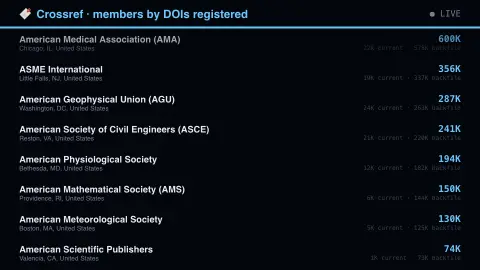
The Who Registers The DOIs screensaver shows crossref members by DOIs registered, key-less. A member is whoever pays to register DOIs, so a learned society with five thousand articles sits in the same list as a commercial publisher with millions. The split between current and backfile is the interesting part: backfile is retrospective digitisation, so a large backfile against a small current count is an organisation that scanned its archive and then slowed down. It's free, runs in your browser, and ESC exits.
Live preview
Press ESC to leave fullscreen. Settings are saved in your browser only.
How the Who Registers The DOIs screensaver works
The saver reads the source described above and draws it on a canvas — no account, no tracking.
Crossref members by DOIs registered, key-less. A member is whoever pays to register DOIs, so a learned society with five thousand articles sits in the same list as a commercial publisher with millions. The split between current and backfile is the interesting part: backfile is retrospective digitisation, so a large backfile against a small current count is an organisation that scanned its archive and then slowed down.
It refreshes on a schedule, so what you see stays current.
Colours can be changed in settings; nothing is stored beyond your own browser.
Members, DOIs and the Crossref backfile
Crossref is the not-for-profit registry behind a large share of scholarly DOIs. To get a DOI prefix and register content through Crossref, an organisation has to become a member, so the list runs from university presses and learned societies to large commercial publishers. Membership carries an annual fee tiered by the higher of the organisation's publishing revenue or publishing operations expenses, and registering content is charged separately.
Crossref's fee pages draw the current and older split. Current records are items published in the current calendar year or the previous two years; older records, which Crossref calls back-year, are anything before that. A large older share therefore often means a member went back and registered archive material, while a large current share means it keeps depositing recent work.
Counts measure registration, not importance or quality. A member with few DOIs may be a respected society publishing one journal, while one with millions may be a large commercial publisher. Members can also deposit in batches, so a sudden jump may be a catalogue upload rather than a burst of new publishing.
A worked example
Crossref members by DOIs registered, key-less. A member is whoever pays to register DOIs, so a learned society with five thousand articles sits in the same list as a commercial publisher with millions. The split between current and backfile is the interesting part: backfile is retrospective digitisation, so a large backfile against a small current count is an organisation that scanned its archive and then slowed down.
Settings & tips
- Accent and Background recolour the display.
- Every value on screen comes from the live source — nothing is simulated.
- Press ESC to leave fullscreen.
Frequently asked questions
- Is this real data?
- Yes — it comes from the source named on this page and is refreshed on a schedule.
- Is a key needed?
- No. This source is fully key-less.
- Is it free?
- Yes, and it runs entirely in your browser.
- How does an organisation become a Crossref member?
- It joins Crossref, either directly or through a sponsor, and pays an annual membership fee tiered by its publishing revenue or expenses. Membership is what gives it a DOI prefix and the ability to register content.
- What counts as current content?
- On Crossref's fee pages, current means published in the current calendar year or the previous two years. Anything older is back-year content.
- Does a high DOI count mean more cited work?
- No. A DOI count shows how much content has been registered, not how often it is read or cited.