Voronoi Cell Growth Screensaver
The Voronoi Cell Growth screensaver computes a real live Voronoi tessellation, where seed points grow into cells that expand to tile the entire plane. It is free, runs in your browser, and ESC exits.
Live preview
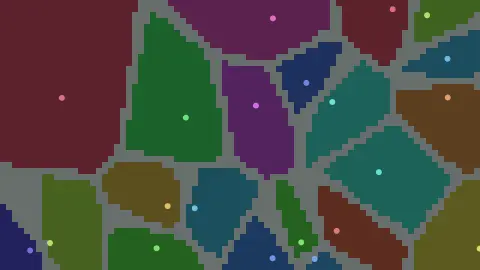
Press ESC to leave fullscreen. Settings are saved in your browser only.
How the Voronoi Cell Growth screensaver works
The saver scatters seed points and computes the real Voronoi diagram — every pixel is assigned to its nearest seed.
Cells are drawn expanding outward from each seed until every boundary meets its neighbors.
Once the plane is fully tiled, new seed points are scattered and the growth restarts.
This is the same real mathematical structure used to model cell packing and crystal growth.
Voronoi diagrams from Dirichlet to dragonflies
A Voronoi diagram divides a plane according to proximity. Given a set of seed points, each point on the plane belongs to the cell of whichever seed is nearest, so the boundaries between cells run exactly halfway between neighbouring seeds. The idea is named for Georgy Voronoi, who defined and studied the general n-dimensional case in 1908. Dirichlet had used two- and three-dimensional versions in 1850, and John Snow's 1854 cholera map is often described as an early, informal example.
For point seeds in the plane, every cell is a convex polygon, and each edge lies along the perpendicular bisector between two seeds. The diagram is the dual of the Delaunay triangulation of the same points, so either one can be derived from the other. Fortune's sweep-line algorithm builds a Voronoi diagram of n points in O(n log n) time.
The nearest-seed rule turns up well beyond mathematics: in hydrology for estimating rainfall from scattered gauges, in ecology for modelling forest canopy growth, in ethology for the selfish-herd idea, and in the study of bone microarchitecture. In the display, the expanding cells are a visual way of showing the same rule.
A worked example
Two neighboring seed points grow toward each other until their expanding cells meet along a shared straight boundary, exactly as Voronoi math predicts.
Settings & tips
- Accent recolours the cell boundaries.
- Based on the real Voronoi tessellation used across cell biology and geography.
- Each cycle scatters fresh random seed points.
Frequently asked questions
- Is this based on real math?
- Yes — the real Voronoi tessellation, widely used in biology, geography and computer graphics.
- Is a key needed?
- No — it is a pure local simulation.
- Is it free?
- Yes — free, no download, in your browser.
- Does the pattern repeat?
- No — new random seed points are scattered each cycle.
- What is the link between Voronoi diagrams and Delaunay triangulations?
- They are duals: for the same set of points, the Voronoi diagram and the Delaunay triangulation can each be derived from the other.
- Why are all the cells convex?
- For point seeds in the plane, each cell is the intersection of half-planes, one for each other seed, and an intersection of half-planes is always convex.
- Where is the Voronoi idea used?
- Examples include rainfall estimation in hydrology, forest canopy models in ecology, the selfish-herd theory in ethology, and bone microarchitecture.