TV Test Card Screensaver (SMPTE Color Bars)
This is a free TV test card screensaver that fills your screen with the classic SMPTE broadcast colour bars — the standard pattern stations once aired when off the air. It runs in your browser with nothing to download, and you press ESC at any time to exit. An optional caption and a live ticking clock can sit on top of the bars.
Live preview
Press ESC to leave fullscreen. Settings are saved in your browser only.
How the Test Pattern screensaver works
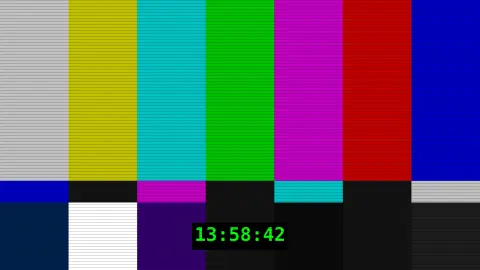
The screen is divided into seven equal vertical columns and three stacked rows, just like a real SMPTE test card. The top row carries the familiar bright bars — grey, yellow, cyan, green, magenta, red and blue — while the thin middle row and the wider bottom row hold the darker reference and black-level patches beneath them.
When the showClock toggle is on, a small black box near the bottom shows a live HH:MM:SS clock in green that updates every second, echoing the on-screen time stamps broadcasters used. Typing into the label field drops a captioned plate in the centre of the bars for a station name or message.
A faint scanlines overlay draws thin dark lines down the whole screen to mimic the look of an old CRT television, completing the retro broadcast feel.
SMPTE colour bars and the history of test cards
The colour-bar pattern behind this saver goes back to a precursor developed at RCA Laboratories, followed by the EIA-189A standard. SMPTE published the 75% colour bar version as ECR 1-1978, and it is used wherever the NTSC standard applies, including North America. The top two-thirds hold seven bars at 75% intensity: grey (or white), yellow, cyan, green, magenta, red and blue, which step down in brightness from left to right.
Each band has a job. A thin strip of blue, magenta, cyan and grey blocks sits under the main bars; viewed through a blue filter, it lets a technician adjust a monitor’s colour controls until the bars appear as four solid blue bars. At the bottom, a 100% white square and a near-black rectangle hold a PLUGE signal, three small bars at 11.5, 7.5 and 3.5 IRE that help set the bottom of the brightness range so blacks neither wash out to grey nor get crushed.
Other countries used other cards. The BBC’s Test Card F, designed by engineer George Hersee, shows his daughter Carole playing noughts and crosses with a clown doll, and was first broadcast on BBC2 on 2 July 1967. It is a different design from the colour bars shown here.
A worked example
With the defaults — an empty label, showClock on and scanlines on — you get clean SMPTE bars with a live clock ticking near the bottom and subtle CRT lines over everything. Type PLEASE STAND BY into the label field to print a caption across the centre, or switch scanlines off for crisp, modern-looking bars.
Settings & tips
- Type any text into the Label field to add a centred caption like a station name or "Please Stand By".
- Turn off Show Clock if you want the bars on their own without the running HH:MM:SS time.
- Toggle Scanlines off for clean, flat colour bars, or leave them on for an authentic CRT look.
Frequently asked questions
- What is a TV test card screensaver?
- It is a screensaver that displays the SMPTE colour bars broadcasters used as a test pattern. The bars let you check a screen's colour and were shown when a station was off the air.
- Is the TV test card screensaver free?
- Yes. It is completely free and runs in your browser with no download, sign-up or install needed.
- How do I exit the test card screensaver?
- Press the ESC key to exit at any time. Moving the mouse or pressing any key also returns you to the page.
- Can I add my own caption to the test pattern?
- Yes. Type text into the Label control and it appears on a plate in the centre of the colour bars, ideal for a station name or a stand-by message.
- Does it show a clock like real broadcast test cards?
- Yes. With Show Clock enabled, a live HH:MM:SS clock ticks near the bottom of the bars, just like the time stamps old test cards displayed.
- Why are the bars in that particular order?
- The seven main bars are arranged from grey or white through yellow, cyan, green, magenta and red to blue, stepping down in brightness from left to right. That fixed order makes colour and brightness errors easy to spot.
- What is the bottom row of dark patches for?
- The near-black rectangle carries a PLUGE signal with small bars at 11.5, 7.5 and 3.5 IRE. It helps set a monitor’s black level so blacks do not wash out to grey or get crushed.
- What is Test Card F?
- It is the BBC test card designed by George Hersee, showing his daughter Carole playing noughts and crosses with a clown doll. It was first broadcast on BBC2 on 2 July 1967.