Self-Playing Pong Screensaver
Self-Playing Pong is a free, browser-based screensaver of a Pong match that plays itself: two computer-controlled paddles rally a single ball back and forth forever, with a glowing CRT look and a running score. There is nothing to download — open the page to watch the endless game and press ESC to exit.
Live preview
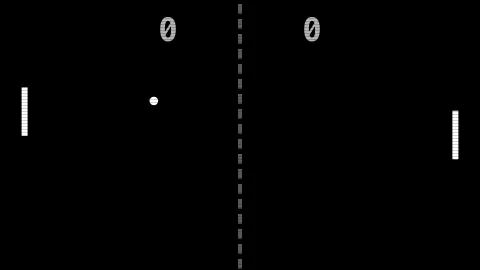
Press ESC to leave fullscreen. Settings are saved in your browser only.
How the Self-Playing Pong screensaver works
The ball moves each frame and bounces off the top and bottom walls. When a paddle hits it, the horizontal direction flips and the ball's vertical speed is nudged by how far from the paddle's center it struck — so off-center hits send it off at sharper angles, exactly like real Pong. If a paddle misses, the other side scores and the ball re-serves from the middle.
Both paddles are driven by a simple AI tied to the Paddle skill control. The paddle on the side the ball is heading toward tracks the ball's height; the idle paddle drifts back toward center. Higher skill makes the tracking tighter and the paddles faster, so rallies last longer; lower skill adds a wobble that makes them miss more often.
Ball speed scales how fast the ball travels across the court. Because a missed ball simply re-serves and the score ticks up, the match never ends — it just keeps rallying and counting.
The look is pure arcade: a dashed center net, two paddles, a square ball, and the score in a big monospace font. With CRT scanlines on, faint dark horizontal lines are laid over everything to mimic an old tube monitor, and your chosen Color tints the paddles, ball, and net.
Pong, and why two bots can play it forever
Pong was built by Atari engineer Allan Alcorn in 1972 as a training exercise assigned by Atari co-founder Nolan Bushnell, who based the concept on the electronic table tennis game on the Magnavox Odyssey. Bushnell and co-founder Ted Dabney were impressed enough to manufacture it, and the arcade version was announced in November 1972. The arcade cabinet had no microprocessor; it used transistor-transistor logic circuits.
One quirk of the arcade design is how the ball's angle was decided. Rather than simulate physics, Alcorn divided each paddle into eight segments: the centre segments returned the ball at a near-perpendicular angle, while the outer segments sent it off at shallower angles, which gave players a way to aim. The ball also accelerated the longer it stayed in play, and a miss reset its speed.
A self-playing version turns the game into a small demonstration of control. Each computer paddle only has to track the ball's vertical position, and if it follows too perfectly the rally never ends. Giving a bot limited speed or a small aiming error is what makes points actually get scored, so the watchable rhythm of misses and rallies comes from deliberately imperfect players.
A worked example
At the defaults — Ball speed 5, Paddle skill 7, white Color on a black Background, CRT scanlines on — the ball serves from center and the two paddles trade long rallies, each off-center hit kicking the ball to a steeper angle, while the score climbs above the net. Lower Paddle skill toward 1 and the paddles start fumbling for quick points; raise Ball speed to 10 for a frantic, fast-twitch match.
Settings & tips
- Raise Paddle skill for marathon rallies where the paddles rarely miss, or lower it so points come fast and the score climbs quickly.
- Use Ball speed to set the overall pace — gentle and watchable at the low end, frantic near the top.
- Turn off CRT scanlines for a clean modern look, and tint everything with the Color swatch for a phosphor-green or amber arcade feel.
Frequently asked questions
- Is the self-playing Pong screensaver free?
- Yes. It runs free in your browser with no download or install. Open the page and the match starts playing itself.
- Do I play the Pong game?
- No. Both paddles are controlled by the computer — it's a screensaver, so the match plays itself endlessly while you watch.
- How do I exit the Pong screensaver?
- Press the ESC key to close it. Moving the mouse or clicking also returns you to the page.
- Can I make the rallies last longer?
- Yes. Raise the Paddle skill slider so the paddles track the ball more accurately and miss less often, which makes rallies longer.
- What do the CRT scanlines do?
- They overlay faint dark horizontal lines to mimic an old tube monitor. You can turn them off for a clean, modern look.
- Who invented Pong?
- Allan Alcorn built the Atari arcade game in 1972 on the assignment of Atari co-founder Nolan Bushnell. It was based on the Odyssey's table tennis game, and Magnavox later sued Atari for patent infringement; they settled in 1976 with Atari becoming a licensee.
- Why does the ball go faster in some rallies?
- In the arcade original the ball accelerated the longer it stayed in play, and a miss reset its speed, so long volleys became harder to sustain.