Turing Patterns Screensaver
The Turing Patterns screensaver runs the Gray-Scott reaction-diffusion model across the surface of a sphere, growing spots and stripes from an almost uniform start. It runs in the browser with nothing to install; press ESC to exit.
Live preview
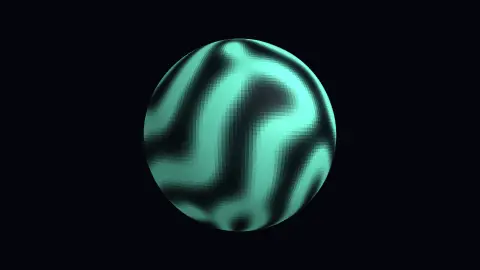
Press ESC to leave fullscreen. Settings are saved in your browser only.
How the Turing Patterns screensaver works
The saver renders with three.js on your GPU. The library is vendored into this site rather than fetched from a CDN, and loads only when a 3D screensaver actually runs.
It reads nothing external — the simulation runs in the browser.
The scene resizes with the window and releases its WebGL context when the saver stops, so shuffle mode and Multi-view can cycle 3D savers without exhausting the browser's context limit.
If WebGL is unavailable the saver says so on screen rather than showing an empty black box.
Turing's morphogenesis and the Gray-Scott model
In 1952 the mathematician Alan Turing published The Chemical Basis of Morphogenesis, asking how a uniform embryo could develop structure. His proposal was that two chemicals, spreading through tissue at different rates and reacting with each other, could spontaneously break symmetry and form stable spots or stripes. Reaction-diffusion models of this kind have since been used to study animal skin patterns and finger development.
The Gray-Scott model, from work by Peter Gray and Stephen Scott in the early 1980s, is a concrete version. There are two chemicals, usually called U and V. V consumes U to make more V, while U is fed in at a steady rate and V is removed at another. Because U diffuses faster than V, small differences grow instead of fading. Two parameters, the feed rate and kill rate, decide whether the result is spots, stripes, maze-like labyrinths or pulsing blobs, and John Pearson’s 1993 Science paper Complex Patterns in a Simple System mapped how many forms the model could produce.
The pattern settles when production and diffusion balance, which is why it eventually stops moving. On a sphere there are no edges, so the pattern wraps continuously. It is a simulation of an abstract chemical system, and real animal markings arise from more complicated biology, although the same principle is believed to be involved.
A worked example
Two substances: one fed in steadily, one that consumes it and is removed. Both diffuse, but one twice as fast as the other, and that asymmetry is the entire mechanism. Alan Turing showed in 1952 that it alone can break a uniform state into a stable pattern, which remains the leading explanation for why animals have spots and stripes. Running it on a closed surface means the pattern has nowhere to escape to.
Settings & tips
- Accent and Background recolour the scene; Speed changes the pace of the motion and the camera.
- Add it to a Multi-view grid, though 3D savers are heavier than 2D ones and a few per screen is plenty.
- Press ESC at any time to leave fullscreen.
Frequently asked questions
- Did Turing really predict this?
- Yes, in 'The Chemical Basis of Morphogenesis' in 1952, before anyone could run the equations. Chemical systems producing exactly these patterns were not demonstrated in the laboratory until the 1990s.
- Why does the pattern stop changing?
- Because it reaches equilibrium. Given the feed and kill rates chosen, the system settles into a configuration that sustains itself, which is precisely what makes these patterns useful as an explanation for stable markings on an animal.
- Does this need a special browser or plugin?
- No. It uses WebGL, which every current desktop and mobile browser supports. Nothing is installed and no plugin is required.
- Does it cost anything or need an account?
- No. Every screensaver here is free, runs in the browser and needs no sign-up.
- What do the feed and kill rates control?
- Feed is how fast chemical U is replenished, and kill is how fast V is removed. Small changes in either move the system between spots, stripes and mazes.
- Do real animals use this mechanism?
- Related reaction-diffusion processes are thought to help shape patterns such as fish stripes and digit spacing, though real development involves many more factors.
- Why do the two chemicals need different diffusion speeds?
- If they spread equally fast, differences would smooth out. The mismatch lets a local excess of one chemical hold its place while the other leaks away, which locks in structure.