The Web's Actual Front Door Screensaver
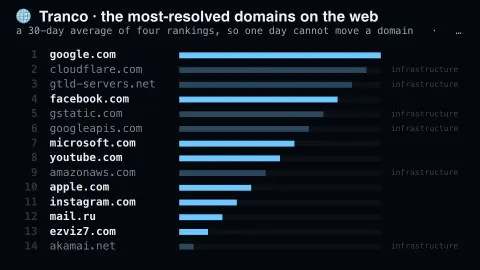
The The Web's Actual Front Door screensaver shows the head of the Tranco list, gathered key-less by the pipeline. It's free, runs in your browser, and ESC exits.
Live preview
Press ESC to leave fullscreen. Settings are saved in your browser only.
How the The Web's Actual Front Door screensaver works
The saver reads the source described above and draws it on a canvas — no account, no tracking.
The head of the Tranco list, gathered key-less by the pipeline. It averages four rankings over 30 days so no single day can move a domain, and the result is mostly infrastructure — CDN edges and DNS roots your browser visits on your behalf.
It refreshes on a schedule, so what you see stays current.
Colours and any options can be changed in settings; nothing is stored beyond your own browser.
What the Tranco list is for
Tranco is a ranking of popular domains built by researchers to give security and web-measurement studies a more reliable top-sites list; it was introduced in a 2019 paper at the NDSS symposium. Earlier lists could be manipulated or changed abruptly, which damaged the reproducibility of research that depended on them. Each Tranco list has an identifier so a study can cite exactly the version it used.
It works by combining several existing rankings and averaging a domain's position across them and across a 30-day window, scoring ranks with the Dowdall rule, which gives items 1, 1/2, 1/3 and so on. The providers it documents are the Chrome User Experience Report (CrUX), Cloudflare Radar, Farsight, Majestic and Cisco Umbrella; Alexa and Quantcast were used in the past. Mixing very different measurement methods reduces the influence of any single source's quirks.
Reading the display, remember that rank reflects what those measurement sources observe, not what people deliberately visit. Domains such as content-delivery networks and DNS infrastructure rank high because browsers contact them in the background. How subdomains are counted varies by source: some providers rank only pay-level domains, while others fold in subdomain traffic.
A worked example
The head of the Tranco list, gathered key-less by the pipeline. It averages four rankings over 30 days so no single day can move a domain, and the result is mostly infrastructure — CDN edges and DNS roots your browser visits on your behalf.
Settings & tips
- Accent and Background recolour the display.
- Every value on screen comes from the live source — nothing is simulated.
- Press ESC to leave fullscreen.
Frequently asked questions
- Is this real data?
- Yes — it comes from the source named on this page and is refreshed on a schedule.
- Is a key needed?
- No. This source is fully key-less.
- Is it free?
- Yes, and it runs entirely in your browser.
- Why do domains I never type appear so high?
- Many are infrastructure, such as content delivery and DNS domains, that browsers and apps contact automatically.
- Why average over 30 days?
- Tranco averages ranks over the past 30 days so that a single day's spike has limited effect, which supports reproducible research.
- What is the list ID for?
- Each generated list has an identifier so papers can cite the exact ranking used.