Bern, Item by Item Screensaver
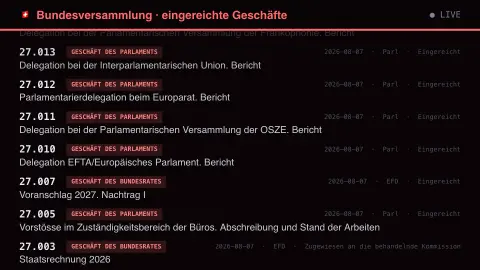
The Bern, Item by Item screensaver shows business submitted to the Swiss Federal Assembly, from the parliament's key-less OData service. Shown in German deliberately: the service accepts a request for English and answers 200, but the rows it returns are French, so asking for English quietly gets you a fallback. It's free, runs in your browser, and ESC exits.
Live preview
Press ESC to leave fullscreen. Settings are saved in your browser only.
How the Bern, Item by Item screensaver works
The saver reads the source described above and draws it on a canvas — no account, no tracking.
Business submitted to the Swiss Federal Assembly, from the parliament's key-less OData service. Shown in German deliberately: the service accepts a request for English and answers 200, but the rows it returns are French, so asking for English quietly gets you a fallback.
It refreshes on a schedule, so what you see stays current.
Colours and any options can be changed in settings; nothing is stored beyond your own browser.
How the Swiss Federal Assembly files its business
Switzerland’s parliament, the Federal Assembly, consists of the 200-seat National Council and the 46-seat Council of States. The Federal Constitution gives the two chambers equal standing, and federal laws and decrees must be approved by both. The National Council represents the people, with its seats allotted to the 26 cantons according to population; the Council of States represents the cantons, with two seats each except the six half-cantons, which have one. The parliament’s online service lists the business before it, which Swiss usage calls Geschäfte.
Parliamentary instruments differ in what they ask of the government. A motion gives the Federal Council a mandate to take a measure or submit a draft act. A postulate instead charges it with examining whether a measure or draft act is worthwhile, and it counts as met once the Federal Council reports back. An interpellation asks it for information on a matter concerning the Confederation, and the answer is generally due by the next session.
The titles on screen are in the language the service returns. That a matter is listed means it has been submitted or is being treated, not that it will pass.
A worked example
Business submitted to the Swiss Federal Assembly, from the parliament's key-less OData service. Shown in German deliberately: the service accepts a request for English and answers 200, but the rows it returns are French, so asking for English quietly gets you a fallback.
Settings & tips
- Accent and Background recolour the display.
- Every value on screen comes from the live source — nothing is simulated.
- Press ESC to leave fullscreen.
Frequently asked questions
- Is this real data?
- Yes — it comes from the source named on this page and is refreshed on a schedule.
- Is a key needed?
- No. This source is fully key-less.
- Is it free?
- Yes, and it runs entirely in your browser.
- What is the difference between a motion and a postulate?
- Under the Parliament Act, a motion gives the Federal Council a mandate to take a measure or submit a draft act, while a postulate charges it with examining whether doing so is worthwhile. A postulate is considered met once the Federal Council reports back.
- What is an interpellation?
- It is an instrument by which a member asks the Federal Council for information on a matter concerning the Confederation. The Federal Council generally answers by the next session.