What Denmark Is Deciding Screensaver
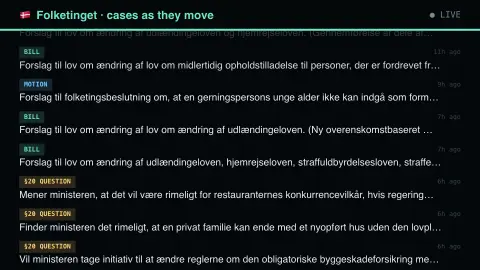
The What Denmark Is Deciding screensaver shows live cases from the Folketing's own open data service, key-less. Filtered to bills, private members' motions and § 20 questions to ministers — sorted raw, the feed is almost entirely near-identical EU Commission scrutiny paperwork. It's free, runs in your browser, and ESC exits.
Live preview
Press ESC to leave fullscreen. Settings are saved in your browser only.
How the What Denmark Is Deciding screensaver works
The saver reads the source described above and draws it on a canvas — no account, no tracking.
Live cases from the Folketing's own open data service, key-less. Filtered to bills, private members' motions and § 20 questions to ministers — sorted raw, the feed is almost entirely near-identical EU Commission scrutiny paperwork.
It refreshes on a schedule, so what you see stays current.
Colours and any options can be changed in settings; nothing is stored beyond your own browser.
Reading Danish parliamentary cases
The Folketing is Denmark’s single-chamber parliament, with 179 members, two of them elected in Greenland and two in the Faroe Islands. Its sessional year starts on the first Tuesday of October, and its open data service publishes cases such as bills, motions and questions in a machine-readable form.
The three types shown here are quite different. A lovforslag is a bill, and the Danish constitution says no bill may be finally passed until it has been read three times in the Folketing. A beslutningsforslag is a motion asking the Folketing to resolve that something should happen; these are not changes to the law themselves, they get two readings, and many fail to win a majority. A § 20 question is a question put in writing by a member to a minister under section 20 of the Folketing’s rules of procedure, asking for the minister’s position on a current issue.
Most titles are in Danish, and a bill’s title usually names the act it would amend. The service holds far more material than this, including EU scrutiny documents, which is why the saver filters. A case appearing here means it was registered, not that it will pass.
A worked example
Live cases from the Folketing's own open data service, key-less. Filtered to bills, private members' motions and § 20 questions to ministers — sorted raw, the feed is almost entirely near-identical EU Commission scrutiny paperwork.
Settings & tips
- Accent and Background recolour the display.
- Every value on screen comes from the live source — nothing is simulated.
- Press ESC to leave fullscreen.
Frequently asked questions
- Is this real data?
- Yes — it comes from the source named on this page and is refreshed on a schedule.
- Is a key needed?
- No. This source is fully key-less.
- Is it free?
- Yes, and it runs entirely in your browser.
- What is a § 20 question?
- A written question from a member of the Folketing to a minister under section 20 of the rules of procedure, asking for the minister’s position on a current issue.
- Does a case on the list become law?
- Only bills can become law, and none is finally passed until it has been read three times in the Folketing. Motions are not laws, and many fail to win a majority.
- Why are titles in Danish?
- The case titles come from the Folketing’s own records, which are written in Danish.