What Rhymes With That Screensaver
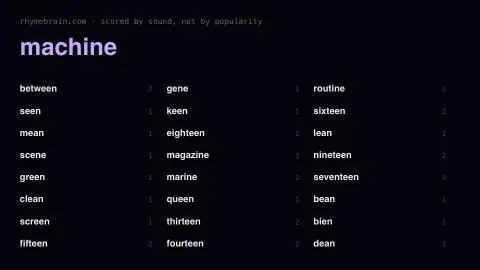
The What Rhymes With That screensaver shows rhymes for a rotating set of words, ranked by RhymeBrain's phonetic score rather than by how common the words are. It runs in the browser with nothing to install; press ESC to exit.
Live preview
Press ESC to leave fullscreen. Settings are saved in your browser only.
How the What Rhymes With That screensaver works
The saver reads rhymebrain.com, key-free.
No account and no key: the request goes straight from your browser, or from this site's own refreshed copy of the feed where the source does not permit browser access.
Values are drawn on a canvas that resizes with the window, so it works on a laptop or a wall display.
If the source is unreachable the saver says so on screen rather than showing stale numbers as though they were current.
How rhyme is judged by ear, not by spelling
A rhyme is a matter of sound. Two words rhyme perfectly when everything from the last stressed vowel onward matches, while the sounds before it differ: light and night do, while light and lit do not. English spelling is a poor guide, since though, through and tough share letters and none of them rhyme, so any useful rhyming tool has to work from pronunciation rather than word endings.
RhymeBrain computes its rhymes on each request, finding words that sound similar, and gives each a score it calls RhymeRank. By its documentation, scores of 300 and above are perfect rhymes and lower scores are near rhymes, also called slant or half rhymes. Its pronunciations are derived with machine learning and may not always be accurate, so unusual proper names or invented words can be guessed. Songwriters use near rhymes deliberately because perfect rhymes can sound sing-song.
Rhyme also depends on accent. A pair such as cot and caught rhymes for speakers who pronounce them alike and not for those who keep them apart, so any ranking reflects one model of pronunciation.
A worked example
The word sits at the top and its rhymes fill the screen in columns, perfect rhymes drawn bright and near rhymes dimmed, with syllable counts alongside. Scoring by sound rather than by frequency is what makes it more interesting than a dictionary lookup: the perfect rhymes at the top are the ones a songwriter would actually reach for.
Settings & tips
- Accent and Background recolour the display without changing the data.
- Add it to a Multi-view grid to watch it alongside other live savers.
- Press ESC at any time to leave fullscreen.
Frequently asked questions
- What does the score mean?
- An estimate of how well the words rhyme phonetically, with a perfect rhyme at 300 and near rhymes below. It is about sound, not about how common or useful the word is.
- Why do some rhymes look like non-words?
- Because the engine works from pronunciation and its dictionary includes abbreviations, names and rare forms. A phonetically perfect match is not always a word you would use.
- Is this real data?
- Yes. It comes from rhymebrain.com, key-free. Nothing is invented or simulated, and if the source cannot be reached the saver reports that instead of drawing something plausible.
- Does it cost anything or need an account?
- No. Every screensaver here is free, runs in the browser and needs no sign-up. This one uses a public API that requires no key.
- What is a near rhyme?
- A near rhyme, or slant rhyme, matches only part of the ending sound, such as the vowel or the closing consonant. Poets and lyricists use it to avoid the predictability of perfect rhymes.
- Do rhymes change with accent?
- Yes. Whether two words rhyme depends on how they are pronounced, so a pair that works in one regional accent may not in another.
- What does the RhymeBrain score mean?
- It is RhymeBrain's own RhymeRank value. Scores of 300 and above are perfect rhymes, and lower scores are near rhymes.