World Population Clock Screensaver
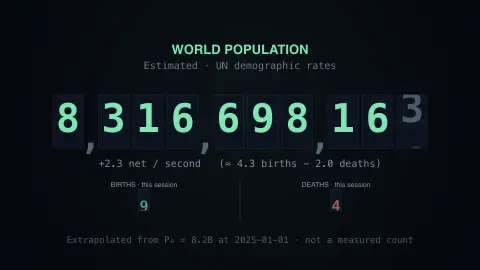
The Population Clock screensaver is a live world population odometer that ticks up second by second — births, deaths and net growth — extrapolated from the latest United Nations demographic rates on rolling split-flap counters. It's free, runs in your browser, and ESC exits.
Live preview
Press ESC to leave fullscreen. Settings are saved in your browser only.
How the Population Clock screensaver works
The saver starts from a recent United Nations world population figure and the UN's estimated birth and death rates per second.
It computes the current population continuously from the time elapsed, so the headline counter climbs in real time.
Two smaller counters tally the births and deaths that have ticked by since you opened the saver.
Every figure rolls on mechanical odometer-style reels, and the panel notes that the numbers are estimates from UN rates.
How a world population clock is built
The United Nations Population Division, part of the UN Department of Economic and Social Affairs, publishes the World Population Prospects, a set of estimates and projections for countries and regions. Revisions now come roughly every two to three years; the 2024 Revision was the 28th edition. Its estimates draw on national censuses and surveys, and the 2024 Revision used more than 1,900 censuses from 1950 to 2023.
A clock like this takes a base figure for a given date and adds a net growth rate per second. Birth and death rates are annual averages, so the counter assumes the flow is smooth even though births and deaths vary by hour and season. The result is an extrapolation: it looks precise to the last digit, but the underlying estimate is not.
The UN says as much. Its projections are published in several variants (medium, low and high among them) and use a probabilistic model for fertility and, since the 2024 Revision, for international migration. Other organisations publish their own world population estimates, built on different methods and base dates, so two clocks need not agree. The figure is better treated as an approximation than a count.
A worked example
The big counter rolls past 8,200,000,000 and keeps climbing roughly two people per second, while the births and deaths reels beneath it tally up everyone added and lost since the saver started — a quiet, hypnotic sense of the planet's scale.
Settings & tips
- Accent recolours the rolling digits.
- Background sets the panel backdrop.
- It needs no internet — the counters are computed from UN rates on your device.
Frequently asked questions
- Is the number exact?
- No — nobody counts the world in real time. It's an estimate extrapolated from the UN's population figure and average birth/death rates, the same method as public population clocks.
- Does it need an internet connection?
- No. Everything is computed locally from built-in UN rates, so it runs fully offline.
- Where do the rates come from?
- From United Nations demographic estimates of global births and deaths per second, used to extrapolate the count.
- Why do the births and deaths reset?
- Those two counters tally activity since you opened the saver, so they start from zero each session.
- Is it free?
- Yes — free, no download, in your browser.
- Why can different population clocks show different totals?
- Organisations use different methods, data sources and base dates, so their estimates differ. A clock also depends on a chosen growth rate extrapolated from a base date.
- Where do the UN's population figures come from?
- Mainly national censuses and surveys. The 2024 Revision of World Population Prospects used more than 1,900 censuses from 1950 to 2023, plus thousands of surveys, and fills gaps with demographic models.
- How often are the UN estimates updated?
- Revisions of World Population Prospects now come roughly every two to three years, so a clock built on one drifts from newer estimates until it is updated.