Please Stand By Screensaver
The Please Stand By screensaver recreates the classic broadcast-interruption test card seen during mid-century television technical difficulties. It is free, runs in your browser, and ESC exits.
Live preview
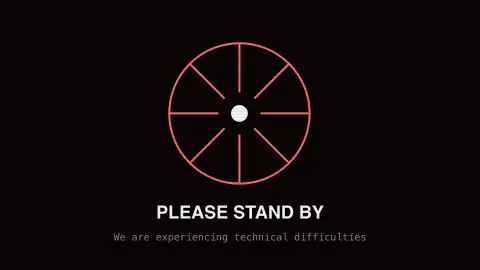
Press ESC to leave fullscreen. Settings are saved in your browser only.
How the Please Stand By screensaver works
The saver renders a classic test-card layout with a centered geometric pattern and bold "PLEASE STAND BY" text.
A subtle scanline and flicker effect gives it an authentic analog-broadcast feel.
The pattern gently animates to avoid any static burn-in.
No real broadcast signal is involved — it is a purely visual effect.
The story behind the test card
Early television broadcasters needed a fixed image to transmit when no programme was running, so engineers could adjust equipment and viewers could tune receivers. A test card is usually shown when the transmitter is on but nothing is airing, such as at sign-on and sign-off. Test patterns, such as the RCA Indian-head pattern used mainly in North America from 1940 into the 1970s and the BBC’s Test Card F, included circles, grids, gratings and grey scales.
Each element had a purpose: large circles checked the linearity of a set’s deflection, grids helped with picture geometry, gratings tested resolution and grey scales were used to adjust brightness and contrast. Test Card F was developed by BBC engineer George Hersee and first aired on BBC2 on 2 July 1967. It shows his daughter Carole playing noughts and crosses with a clown doll called Bubbles.
The phrase ‘please stand by’ is remembered as a symbol of analogue television. Because most broadcasters now run around-the-clock schedules, fixed test patterns have become rare. On a modern screen, a static image left for long periods can leave a faint ghost on some display types, so a slow drift and slight flicker suit a screensaver. The scanlines here echo how analogue tube sets drew the picture line by line.
A worked example
Left running, it reads exactly like the technical-difficulty card that used to interrupt live broadcasts — a nostalgic, calming visual.
Settings & tips
- Accent recolours the test-card pattern.
- The subtle animation prevents any static burn-in on modern displays.
- A nostalgic nod to analog broadcast television.
Frequently asked questions
- Is this a real broadcast signal?
- No — it is a purely visual recreation of the classic test-card style.
- Is a key needed?
- No — it is a pure visual animation.
- Is it free?
- Yes — free, no download, in your browser.
- Will it burn in on my screen?
- The pattern gently animates specifically to avoid that.
- Why did stations show test patterns?
- They let engineers check a transmitter’s output and let viewers and technicians adjust sets. Circles, grids, gratings and grey scales made faults in geometry, resolution and brightness easy to spot.
- What is Test Card F?
- A BBC test card developed by engineer George Hersee and first shown on BBC2 on 2 July 1967. It features his daughter Carole playing noughts and crosses with a clown doll called Bubbles.
- What are scanlines?
- Analogue tube televisions drew the picture as a series of horizontal lines. On this screensaver the lines are a visual effect meant to resemble that look.