Planetary Retrograde Tracker Screensaver
The Planetary Retrograde Tracker screensaver shows which planets are really retrograde right now. It is free, runs in your browser, and ESC exits.
Live preview
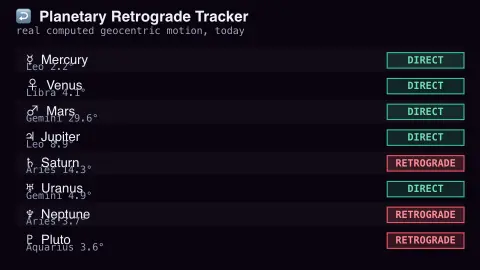
Press ESC to leave fullscreen. Settings are saved in your browser only.
How the Planetary Retrograde Tracker screensaver works
The saver computes each planet's real geocentric ecliptic longitude today and tomorrow.
A planet is marked retrograde when that real longitude is decreasing.
Each row also shows the planet's real current zodiac sign and degree.
Everything is computed locally — no network, no key.
The sky mechanics behind a planet going backwards
Seen from Earth, planets generally drift eastward against the background stars night after night. Occasionally one appears to slow, stop and move westward for weeks or months before reversing again. This apparent backwards motion is called retrograde, and the turning points are known as stations. It puzzled ancient astronomers, who explained it with epicycles, circles riding on circles.
Copernicus’s heliocentric picture gave a simpler answer: retrograde is a perspective effect. The planets orbit the Sun at different speeds, and when Earth passes an outer planet, or an inner planet passes Earth, the line of sight shifts, like a car overtaking a slower one and seeming to slide backwards against the scenery. The centre of an outer planet’s retrograde falls at opposition, when it is opposite the Sun and closest to Earth. Mercury and Venus never reach opposition; their retrograde is tied to inferior conjunction, when they pass between Earth and the Sun.
Duration grows with distance: roughly 22 days for Mercury, 41 for Venus, 72 for Mars and 121 to 158 days for Jupiter through Neptune. The effect is fully real and predictable; what astrology attaches to it is a cultural tradition with no scientific support. Exact dates depend on the position calculation used.
A worked example
When Mercury's real longitude is moving backward through the zodiac, the board marks it RETROGRADE instead of DIRECT.
Settings & tips
- Retrograde motion is a real optical effect of relative orbital speeds.
- Accent recolours the retrograde badges.
- The Sun and Moon are never retrograde and are not listed.
Frequently asked questions
- Is retrograde motion real?
- Yes — it is a genuine apparent effect of Earth and another planet's relative orbital speeds, not folklore.
- How is it computed?
- By comparing each real planet's computed ecliptic longitude one day apart.
- Is a key needed?
- No. Everything is computed locally in your browser.
- Is it free?
- Yes — free, no download, in your browser.
- Why are the Sun and Moon never retrograde?
- Seen from Earth, both keep moving eastward against the stars. Retrograde is an effect of Earth and another planet passing each other on their orbits, which does not apply to them.
- How long does a retrograde last?
- It depends on the planet: about three weeks for Mercury, about six weeks for Venus, and roughly two and a half months for Mars. For Jupiter, Saturn, Uranus and Neptune it lasts between four and five months.
- Do planets really move backwards?
- No. Their orbits keep going the same way; retrograde is an apparent motion caused by the changing viewpoint from a moving Earth.