Physics Citation Canon Screensaver
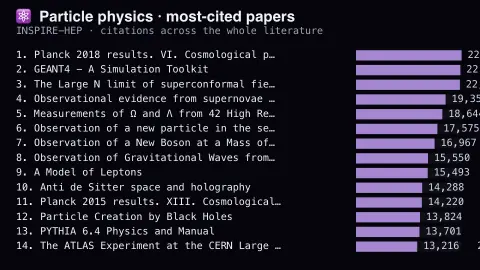
The Physics Citation Canon screensaver shows the most-cited papers in high-energy physics from INSPIRE-HEP, key-less. It's free, runs in your browser, and ESC exits.
Live preview
Press ESC to leave fullscreen. Settings are saved in your browser only.
How the Physics Citation Canon screensaver works
The saver reads the source described above and draws it on a canvas — no account, no tracking.
The most-cited papers in high-energy physics from INSPIRE-HEP, key-less. Deliberately a citation ranking rather than a newest-first feed: INSPIRE sorts most-recent by journal issue date, which puts papers with a future cover date at the top.
It refreshes on a schedule, so what you see stays current.
Colours and any options can be changed in settings; nothing is stored beyond your own browser.
How INSPIRE ranks physics papers
INSPIRE-HEP is a literature database for high-energy physics, the field that studies particles, forces and cosmology. It is run by seven member institutions, including CERN, DESY, Fermilab, SLAC, IHEP and IN2P3, and it replaced SPIRES, the Stanford-based database that had been the field’s main literature index since the 1970s. As well as papers it holds citation metrics, plots extracted from papers, and directories of people, institutions, conferences, jobs and experiments.
The ranking on screen is by citation count, meaning how many other records in the database cite each paper. High counts tend to belong to foundational works such as Standard Model papers, key results from particle experiments, reviews and widely used computing tools. Papers from large experiments are signed by very large collaborations, which is why some list thousands of authors.
Citation totals accumulate, so older papers have an advantage and recent landmark work needs years to climb. Counts treat all citations equally, and a high count says a paper is widely used, not that it is right. One popular review can outrank original discoveries.
A worked example
The most-cited papers in high-energy physics from INSPIRE-HEP, key-less. Deliberately a citation ranking rather than a newest-first feed: INSPIRE sorts most-recent by journal issue date, which puts papers with a future cover date at the top.
Settings & tips
- Accent and Background recolour the display.
- Every number on screen comes from the live source — nothing is simulated.
- Press ESC to leave fullscreen.
Frequently asked questions
- Is this real data?
- Yes — it comes from the source named on this page and is refreshed on a schedule.
- Is a key needed?
- No. This source is fully key-less.
- Is it free?
- Yes — free, no download, in your browser.
- Why do some papers list thousands of authors?
- Large experiments are run by big collaborations, and their papers are signed by the collaboration’s members.
- Does a high citation count prove a paper is correct?
- No. It shows the paper is widely referenced, which can happen for reviews, tools or even results later disputed.
- What was SPIRES?
- SPIRES was the Stanford Physics Information Retrieval System, the main high-energy physics literature database from the 1970s. INSPIRE fully replaced it in 2012.