Pathogen Evolution Screensaver
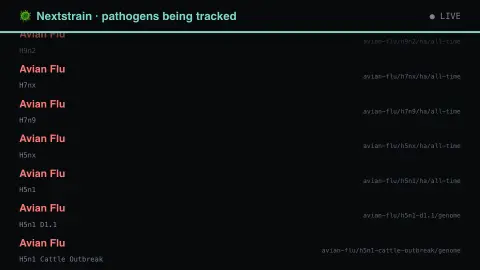
The Pathogen Evolution screensaver shows the live phylogenetic builds public-health teams maintain on Nextstrain: which viruses and bacteria are being tracked right now, and which genes or segments each build covers. It's free, runs in your browser, and ESC exits.
Live preview
Press ESC to leave fullscreen. Settings are saved in your browser only.
How the Pathogen Evolution screensaver works
The saver reads Nextstrain directly in your browser — no key and no account.
The live phylogenetic builds public-health teams maintain on Nextstrain: which viruses and bacteria are being tracked right now, and which genes or segments each build covers..
It refreshes on a schedule, so what you see stays current.
Colours can be changed in settings; nothing is stored beyond your own browser.
What a Nextstrain build is
Nextstrain is an open-source project that uses pathogen genome data to improve understanding of how pathogens spread and evolve and to support outbreak response. Its 2018 description in the journal Bioinformatics, by Hadfield and colleagues with Trevor Bedford and Richard Neher as joint last authors, describes three parts: a database of viral genomes, a pipeline for phylodynamic analysis, and an interactive visualisation platform that can layer on geography, serology or host species.
A tree in Nextstrain is a phylogeny: a family tree of sampled genomes, with branches showing how they diverged through mutation. The nextstrain.org site provides interactive, regularly updated analyses of pathogens such as SARS-CoV-2, influenza and Ebola, and the aim is monitoring in as close to real time as possible.
The saver lists which analyses currently exist and what each covers, rather than reporting case counts or outbreaks. A pathogen being listed means someone is analysing it, which reflects research and surveillance priorities, not the severity of any outbreak. Trees depend on what has been sequenced and shared, so regions with less sequencing are under-represented.
A worked example
The live phylogenetic builds public-health teams maintain on Nextstrain: which viruses and bacteria are being tracked right now, and which genes or segments each build covers.
Settings & tips
- Accent and Background recolour the display.
- Data comes straight from Nextstrain in your browser.
- Press ESC to leave fullscreen.
Frequently asked questions
- Is this real data?
- Yes — it comes from Nextstrain and is refreshed on a schedule.
- Is a key needed?
- No. This source is fully key-less.
- Is it free?
- Yes — free, no download, in your browser.
- Does this show where outbreaks are happening?
- Not directly. It lists the pathogen analyses on Nextstrain, and the picture depends on where sequencing is done and shared.
- What is a phylogenetic tree?
- A branching diagram showing how genomes relate by descent. Closer branches mean fewer mutations separate the samples.
- Is Nextstrain open source?
- Yes. Its code is freely available at github.com/nextstrain and the web application is at nextstrain.org.