Every Registry, Measured Screensaver
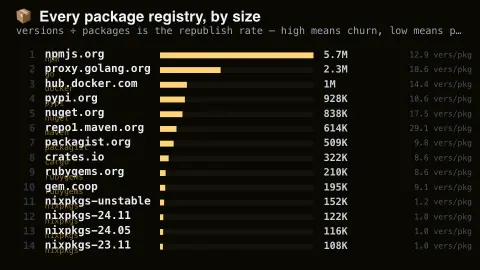
The Every Registry, Measured screensaver shows every major package registry measured end to end by ecosyste.ms, key-less. The ratio beside each count is the story: high versions-per-package means constant churn, low means published once and left alone. It's free, runs in your browser, and ESC exits.
Live preview
Press ESC to leave fullscreen. Settings are saved in your browser only.
How the Every Registry, Measured screensaver works
The saver reads the source described above and draws it on a canvas — no account, no tracking.
Every major package registry measured end to end by ecosyste.ms, key-less. The ratio beside each count is the story: high versions-per-package means constant churn, low means published once and left alone.
It refreshes on a schedule, so what you see stays current.
Colours and any options can be changed in settings; nothing is stored beyond your own browser.
About ecosyste.ms and registry statistics
ecosyste.ms describes itself as tools and datasets to support, sustain and secure critical digital infrastructure. It indexes open-source packages, repositories, security advisories and related activity, and publishes the results through public APIs. It is run by Andrew Nesbitt, who earlier built Libraries.io, and it lists Schmidt Futures and Open Source Collective among its supporters. The code is AGPL-3.0 and the data is licensed CC BY-SA 4.0. The saver uses its registry-level view: each package registry with its totals.
Each registry is shown with a count of packages, a count of versions and the ratio between them. The ratio is a rough measure of culture. A high ratio means authors publish new versions constantly, as when automated pipelines release on every change, while a low ratio suggests packages are published once and left alone. Differences also come from conventions and tooling: some ecosystems favour tiny single-purpose libraries, others larger bundles.
Counts are what the index has collected, so they are a good rough guide but not a precise census, and they change as data is refreshed. A bigger registry is not a better one; a registry with millions of packages includes a lot of experiments, duplicates and abandoned entries. The numbers describe volume, not use or quality.
A worked example
Every major package registry measured end to end by ecosyste.ms, key-less. The ratio beside each count is the story: high versions-per-package means constant churn, low means published once and left alone.
Settings & tips
- Accent and Background recolour the display.
- Every value on screen comes from the live source — nothing is simulated.
- Press ESC to leave fullscreen.
Frequently asked questions
- Is this real data?
- Yes — it comes from the source named on this page and is refreshed on a schedule.
- Is a key needed?
- No. This source is fully key-less.
- Is it free?
- Yes, and it runs entirely in your browser.
- What does the versions per package ratio show?
- It shows how many versions packages in that registry have on average. A high number points to frequent releases, a low one to publish and forget.
- Are these counts exact?
- No. They reflect what ecosyste.ms has indexed and can differ from the registries' own figures.
- Does a larger registry mean more used software?
- Not necessarily. Package counts include many unused or experimental entries, so they measure publication volume rather than adoption.