What The World Bothered To Map Screensaver
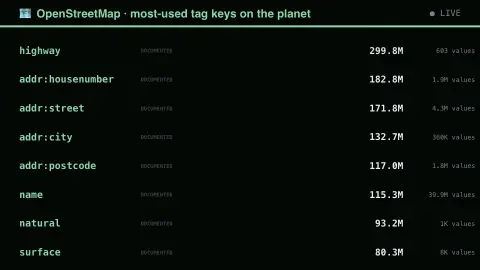
The What The World Bothered To Map screensaver shows the most-used tag keys in OpenStreetMap, key-less from taginfo. The order is a portrait of what mappers considered worth recording: building leads because tracing from aerial imagery is the most parallelisable job in the project, while source ranks absurdly high despite being metadata about the mapping rather than about the world. It's free, runs in your browser, and ESC exits.
Live preview
Press ESC to leave fullscreen. Settings are saved in your browser only.
How the What The World Bothered To Map screensaver works
The saver reads the source described above and draws it on a canvas — no account, no tracking.
The most-used tag keys in OpenStreetMap, key-less from taginfo. The order is a portrait of what mappers considered worth recording: building leads because tracing from aerial imagery is the most parallelisable job in the project, while source ranks absurdly high despite being metadata about the mapping rather than about the world.
It refreshes on a schedule, so what you see stays current.
Colours can be changed in settings; nothing is stored beyond your own browser.
Tags, keys and how OpenStreetMap describes the world
OpenStreetMap is a collaboratively edited world map, and its data model is deliberately simple: points, lines and areas, each carrying free-form tags written as key and value pairs. The key says what kind of property is described, such as highway or building, and the value specifies it, such as residential or yes. Nobody assigns the vocabulary centrally; it grows through community convention and wiki documentation.
Taginfo is a site that shows statistics about which tags are actually in the OpenStreetMap database and how often they are used, and it gathers wiki information about what they mean. The main instance is run by the OpenStreetMap Foundation and maintained by Jochen Topf and the sysadmin team. Mappers use it to check whether a tag is already established before inventing a new one. This display shows keys, ranked by the number of objects that carry them, so a high rank reflects how many things have been mapped with that attribute, not how important it is.
Counts are strongly shaped by how the data gets entered. Import projects and tracing from aerial imagery can add millions of objects with the same key, while a rare but meaningful property may have only a few thousand. Because anyone can use any key, the list also contains typos and experiments, so presence in it does not imply a tag is documented or recommended.
A worked example
The most-used tag keys in OpenStreetMap, key-less from taginfo. The order is a portrait of what mappers considered worth recording: building leads because tracing from aerial imagery is the most parallelisable job in the project, while source ranks absurdly high despite being metadata about the mapping rather than about the world.
Settings & tips
- Accent and Background recolour the display.
- Every value on screen comes from the live source — nothing is simulated.
- Press ESC to leave fullscreen.
Frequently asked questions
- Is this real data?
- Yes — it comes from the source named on this page and is refreshed on a schedule.
- Is a key needed?
- No. This source is fully key-less.
- Is it free?
- Yes, and it runs entirely in your browser.
- What is the difference between a key and a value?
- The key names the property, such as building, and the value gives its detail. Together they form one tag on a map object.
- Who decides which tags exist?
- Nobody centrally. Mappers propose and document tags on the project wiki, and usage by the community determines which ones become common.
- Does a high count mean a feature is more important?
- No. It mostly reflects how many objects carry the key, which depends on how easy something is to map in bulk and whether imports have been run.