One Sentence, Many Languages Screensaver
The One Sentence, Many Languages screensaver shows one English sentence shown beside its translations from the Tatoeba volunteer corpus, gathered key-less by the pipeline. It's free, runs in your browser, and ESC exits.
Live preview
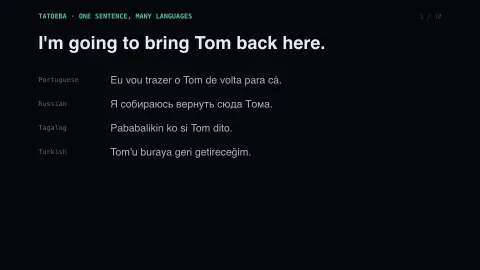
Press ESC to leave fullscreen. Settings are saved in your browser only.
How the One Sentence, Many Languages screensaver works
The saver reads the source described above and draws it on a canvas — no account, no tracking.
One English sentence shown beside its translations from the Tatoeba volunteer corpus, gathered key-less by the pipeline. Tatoeba's translations are written sentence by sentence by speakers rather than generated, so the phrasings are idiomatic rather than literal.
It refreshes on a schedule, so what you see stays current.
Colours and any options can be changed in settings; nothing is stored beyond your own browser.
How the Tatoeba corpus is built
Tatoeba is a free collection of example sentences with translations, geared towards foreign-language learners. Trang Ho founded it in 2006. Volunteers add original sentences, translate existing ones, proofread or comment on others’ sentences, and adopt sentences that have no owner. The result is a large web of sentences linked by translation, published under open licences (generally CC BY) and available to download.
The saver picks an English sentence and shows several translations side by side, labelled by language code. Tatoeba identifies languages with three-letter ISO 639-3 codes, so epo is Esperanto and hun is Hungarian. Because the translations are written sentence by sentence by contributors, the phrasing is meant to carry the meaning rather than follow the English word for word.
Be aware of the limits. Anyone can contribute, so quality varies, and the project flags sentences it considers unreliable and leaves them out of its weekly exports. A translation shown in grey is a translation of a translation, so its meaning may drift from the original. Coverage is also uneven: the corpus spans hundreds of languages, but only a minority have large numbers of sentences.
A worked example
One English sentence shown beside its translations from the Tatoeba volunteer corpus, gathered key-less by the pipeline. Tatoeba's translations are written sentence by sentence by speakers rather than generated, so the phrasings are idiomatic rather than literal.
Settings & tips
- Accent and Background recolour the display.
- Every number on screen comes from the live source — nothing is simulated.
- Press ESC to leave fullscreen.
Frequently asked questions
- Is this real data?
- Yes — it comes from the source named on this page and is refreshed on a schedule.
- Is a key needed?
- No. This source is fully key-less.
- Is it free?
- Yes — free, no download, in your browser.
- What are the three-letter language codes?
- They come from ISO 639-3, an international standard for naming languages, which Tatoeba uses to identify its languages. For example, epo is Esperanto and hun is Hungarian.
- Who writes the sentences?
- Volunteer members of the Tatoeba community. They add sentences, translate them, and comment on or correct each other’s work.
- Why are the sentences so simple?
- Tatoeba is geared towards language learners, so it collects example sentences that learners can study and reuse.