Before The Oireachtas Screensaver
The Before The Oireachtas screensaver shows bills before the Irish houses, read live and key-less from the Oireachtas open API. It's free, runs in your browser, and ESC exits.
Live preview
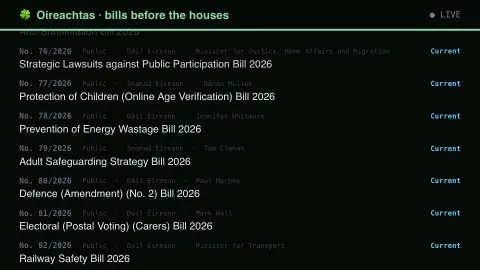
Press ESC to leave fullscreen. Settings are saved in your browser only.
How the Before The Oireachtas screensaver works
The saver reads the source described above and draws it on a canvas — no account, no tracking.
Bills before the Irish houses, read live and key-less from the Oireachtas open API. The sponsor and the type say more about a bill's odds than its title does: a private member's bill can sit at second stage for years while a government bill clears both houses in weeks.
It refreshes on a schedule, so what you see stays current.
Colours and any options can be changed in settings; nothing is stored beyond your own browser.
How a bill moves through the Oireachtas
The Oireachtas is Ireland's parliament, made up of the President and two houses: the Dáil, the directly elected lower house, and the Seanad, the Senate. A bill can start in either house, though money bills must start in the Dáil. In each house a bill passes five stages: first stage, second stage where the general principles are debated, committee stage for section-by-section examination and amendments, report stage and final stage, before going to the other house.
The Oireachtas open data API describes each bill with a title, the house it is currently in, its sponsor, its type and its current stage. The type matters: government bills come from the executive, while private members' bills are introduced by TDs or senators outside government and often make slow progress.
Once both houses pass a bill it goes to the President, who signs it into law, and may first consult the Council of State and refer it to the Supreme Court under Article 26 to test its constitutionality. The display shows a current stage, not a forecast. A bill that sits at one stage for a long time is not necessarily blocked, and bills not completed when the Dáil is dissolved lapse, although a bill can be restored to the order paper by a Dáil resolution.
A worked example
Bills before the Irish houses, read live and key-less from the Oireachtas open API. The sponsor and the type say more about a bill's odds than its title does: a private member's bill can sit at second stage for years while a government bill clears both houses in weeks.
Settings & tips
- Accent and Background recolour the display.
- Every value on screen comes from the live source — nothing is simulated.
- Press ESC to leave fullscreen.
Frequently asked questions
- Is this real data?
- Yes — it comes from the source named on this page and is refreshed on a schedule.
- Is a key needed?
- No. This source is fully key-less.
- Is it free?
- Yes, and it runs entirely in your browser.
- What is a private member's bill?
- It is a bill introduced by an individual TD or senator rather than by the government, and these frequently make slow progress without government support.
- What does the President do with a bill?
- After both houses pass it, the President signs it into law, and may first consult the Council of State and refer it to the Supreme Court for a constitutional check.
- What happens to bills when the Dáil is dissolved?
- Bills that have not completed their passage lapse at dissolution, though the new Dáil can restore them to the order paper by resolution.