How The Commons Divided Screensaver
The How The Commons Divided screensaver shows recorded divisions in the Canadian House of Commons, read live and key-less. It's free, runs in your browser, and ESC exits.
Live preview
Press ESC to leave fullscreen. Settings are saved in your browser only.
How the How The Commons Divided screensaver works
The saver reads the source described above and draws it on a canvas — no account, no tracking.
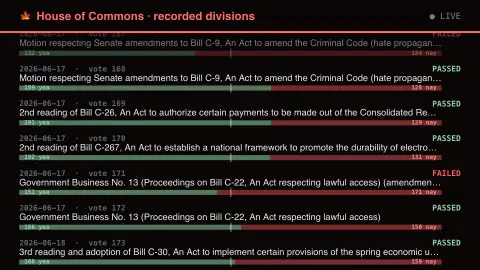
Recorded divisions in the Canadian House of Commons, read live and key-less. The bar is the whole chamber, yeas against nays, with the majority line where it actually falls — so a government surviving by four votes looks different from one carrying the room.
It refreshes on a schedule, so what you see stays current.
Colours and any options can be changed in settings; nothing is stored beyond your own browser.
How a division works in the Canadian House of Commons
In the House of Commons of Canada, the House first votes by voice. If five or more members stand to challenge the result, a recorded division follows, and each member's vote is counted individually. Those in favour rise first and have their names called, then those opposed do the same. The Clerk records the votes while Table Officers tally the yeas and nays, and the Speaker then declares the motion carried or negatived.
The data comes from Open Parliament (openparliament.ca), an independent, non-governmental site launched in 2010 and run by a volunteer. It republishes Canadian parliamentary information, including bills and votes, and offers an API and bulk data for developers. A division usually concerns a bill, an amendment or a motion.
Not every member votes. Pairing lets a government member and an opposition member both stay away without changing the balance, and a member can abstain informally by remaining seated, which is not officially recorded. So the bar shows those who actually voted, not every seat. The display shows how a vote came out, not why, and the motion's wording matters as much as its tally.
A worked example
Recorded divisions in the Canadian House of Commons, read live and key-less. The bar is the whole chamber, yeas against nays, with the majority line where it actually falls — so a government surviving by four votes looks different from one carrying the room.
Settings & tips
- Accent and Background recolour the display.
- Every value on screen comes from the live source — nothing is simulated.
- Press ESC to leave fullscreen.
Frequently asked questions
- Is this real data?
- Yes — it comes from the source named on this page and is refreshed on a schedule.
- Is a key needed?
- No. This source is fully key-less.
- Is it free?
- Yes, and it runs entirely in your browser.
- What is the difference between a recorded division and a voice vote?
- A voice vote is decided by the presiding officer's judgement of the yeas and nays called out. A recorded division, forced when five or more members challenge the result, counts each member's vote by name.
- Does the bar include every member?
- No. It shows members who voted. Members who are absent, paired or who stay seated are not recorded, so the total can be below the number of seats.