OFAC Sanctions Programmes Screensaver
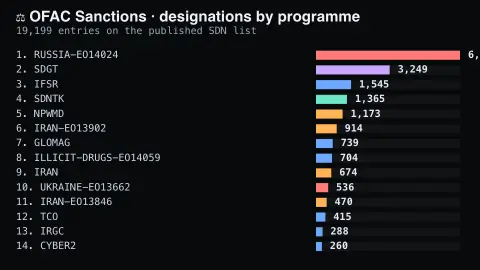
The OFAC Sanctions Programmes screensaver shows how many entries the US Treasury's published sanctions list carries under each programme. The list has no date column, so this shows the standing list broken down by programme rather than new designations. It's free, runs in your browser, and ESC exits.
Live preview
Press ESC to leave fullscreen. Settings are saved in your browser only.
How the OFAC Sanctions Programmes screensaver works
The background pipeline reads this from the US Treasury OFAC published list and saves a snapshot the saver loads.
How many entries the US Treasury's published sanctions list carries under each programme.
It refreshes on a schedule, so what you see stays current.
Colours can be changed in settings; nothing is stored beyond your own browser.
OFAC and its Specially Designated Nationals list
The Office of Foreign Assets Control, or OFAC, is part of the US Treasury Department. It administers economic and trade sanctions based on US foreign policy and national security goals. Its best-known publication is the Specially Designated Nationals and Blocked Persons list, or SDN list. It names individuals, groups and entities, such as terrorists and narcotics traffickers, along with maritime vessels and aircraft that are blocked. The assets of those listed are blocked and US persons are generally prohibited from dealing with them.
Each entry is tagged with one or more programmes, which tie it to the sanctions authority it was listed under. Some programmes are country-based and others are not, such as those aimed at terrorists or narcotics traffickers. Because one entry can carry several programme tags, the counts on the board can overlap, so adding them up will not give the number of distinct entries on the list.
The numbers describe the standing list, not new actions. A listing is an administrative decision by the US government, and listed persons can ask OFAC to reconsider through an administrative process, with removals published in the Federal Register. The SDN list is also not the whole universe of blocked parties, since OFAC’s ownership rules can block entities that are not named on it. Other bodies, including the UN, the EU and the UK, keep their own lists.
A worked example
How many entries the US Treasury's published sanctions list carries under each programme. The list has no date column, so this shows the standing list broken down by programme rather than new designations.
Settings & tips
- Accent and Background recolour the display.
- Run
automation/run.py sanctionsto refresh the feed. - Press ESC to leave fullscreen.
Frequently asked questions
- Is this real data?
- Yes — it comes from the US Treasury OFAC published list and is refreshed on a schedule.
- Does this show new designations?
- No. The published list carries no date column, so this shows the standing list broken down by programme. An entry can sit under several programmes, so programme counts sum to more than the list total.
- Is a key needed?
- No. This source is fully key-less.
- Is it free?
- Yes — free, no download, in your browser.
- Can one entry appear in more than one programme?
- Yes. An entry can carry more than one programme tag, so counts per programme can add up to more than the number of distinct entries.
- What kinds of parties are on the list?
- The SDN list names individuals, groups and entities, plus maritime vessels and aircraft that are blocked by OFAC.
- Can a listing be challenged?
- Yes. Listed persons or their representatives can petition OFAC for removal through its administrative reconsideration process. If granted, the removal is published in the Federal Register.