Notifiable Diseases Screensaver
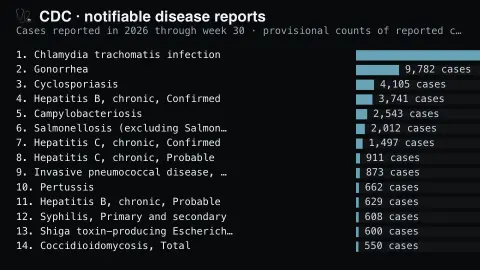
The Notifiable Diseases screensaver shows cases reported so far this year for the diseases US clinicians are legally required to report to the CDC. It's free, runs in your browser, and ESC exits.
Live preview
Press ESC to leave fullscreen. Settings are saved in your browser only.
How the Notifiable Diseases screensaver works
The saver reads the CDC open-data portal directly in your browser — no key and no account.
Cases reported so far this year for the diseases US clinicians must report to the CDC.
It refreshes on a schedule, so what you see stays current.
Colours can be changed in settings; nothing is stored beyond your own browser.
What the NNDSS counts
The National Notifiable Diseases Surveillance System (NNDSS) is run by the US Centers for Disease Control and Prevention, which receives and shares case data from state, local and territorial health departments. Which conditions go on the national list is shaped by the Council of State and Territorial Epidemiologists (CSTE): its position statements recommend conditions for national surveillance, and CDC then posts the annual list of nationally notifiable conditions and issues a yearly memo on changes.
Reporting is based on case definitions that specify what counts as a confirmed or probable case, and CDC publishes them. The numbers reflect only people who were diagnosed and reported. Some diseases are underreported because people do not seek care, are not tested, or because reporting is incomplete, and others may rise partly because of increased testing or changed definitions.
Year-to-date counts therefore build through the year, and CDC distinguishes provisional data from finalized data, so figures can be revised as cases are classified and late reports arrive. Comparing disease totals is not straightforward because conditions differ greatly in how often they are diagnosed. The board reports what the system recorded, and it does not describe risk to any individual or location.
A worked example
Cases reported so far this year for the diseases US clinicians are legally required to report to the CDC, ranked by count.
Settings & tips
- Accent and Background recolour the display.
- Data comes straight from the CDC open-data portal in your browser.
- Press ESC to leave fullscreen.
Frequently asked questions
- Is this real data?
- Yes — it comes from the CDC open-data portal and is refreshed on a schedule.
- Are these all the cases?
- No. They are provisional counts of cases reported to the CDC so far this year, which lag real infections and are revised later. Only the national row is used — summing the state rows as well would double-count every case.
- Is a key needed?
- No. This source is fully key-less.
- Is it free?
- Yes — free, no download, in your browser.
- Why might a count change after it was published?
- Provisional figures can be revised as late reports arrive and cases are reclassified, and CDC distinguishes provisional from finalized data.
- Who decides which diseases are notifiable?
- The Council of State and Territorial Epidemiologists approves position statements that recommend conditions for national surveillance, and CDC publishes the annual list. Reporting requirements themselves come from state, territorial and local authorities.
- Are low counts good news?
- Not always. They may reflect a rare disease, or less testing and reporting, so counts need context from the surveillance system.