Genomes Finished This Month Screensaver
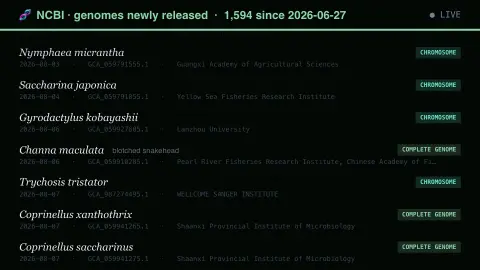
The Genomes Finished This Month screensaver shows genome assemblies newly released to NCBI, key-less. Sequencing a genome was once a decade-long international project; the submitter column shows it is now something a provincial fisheries institute does to a fish. It's free, runs in your browser, and ESC exits.
Live preview
Press ESC to leave fullscreen. Settings are saved in your browser only.
How the Genomes Finished This Month screensaver works
The saver reads the source described above and draws it on a canvas — no account, no tracking.
Genome assemblies newly released to NCBI, key-less. Sequencing a genome was once a decade-long international project; the submitter column shows it is now something a provincial fisheries institute does to a fish.
It refreshes on a schedule, so what you see stays current.
Colours and any options can be changed in settings; nothing is stored beyond your own browser.
What counts as a finished genome
NCBI, the US National Center for Biotechnology Information, runs the Assembly database, which records genome assemblies of organisms, the sequences pieced together from many short reads. Each assembly has an accession in the form accession.version, such as GCA_ followed by digits and a version number. The GCA_ prefix marks a GenBank assembly and GCF_ marks the RefSeq counterpart; the version number rises when an assembly is updated.
The word finished is looser than it sounds. NCBI labels each assembly with a level: contig, scaffold, chromosome or complete genome. Contigs are gapless stretches of sequence; scaffolds join contigs across gaps; chromosome-level assemblies include sequence for one or more chromosomes, which may still contain gaps; and a complete genome has gapless chromosomes with no unplaced sequence. Even then, NCBI notes the chromosomes may not be complete telomere to telomere.
The submitter column is the interesting part of this list. Large sequencing centres appear, but so can universities, hospitals and small regional institutes, a sign of how far sequencing has spread beyond big consortia. A newly released assembly is not necessarily a new species: it can be another strain or individual of something already sequenced, or an improved version of an earlier draft.
A worked example
Genome assemblies newly released to NCBI, key-less. Sequencing a genome was once a decade-long international project; the submitter column shows it is now something a provincial fisheries institute does to a fish.
Settings & tips
- Accent and Background recolour the display.
- Every value on screen comes from the live source — nothing is simulated.
- Press ESC to leave fullscreen.
Frequently asked questions
- Is this real data?
- Yes — it comes from the source named on this page and is refreshed on a schedule.
- Is a key needed?
- No. This source is fully key-less.
- Is it free?
- Yes, and it runs entirely in your browser.
- What does the accession number tell me?
- The prefix shows the database: GCA_ for GenBank, GCF_ for the RefSeq copy. Accessions take the form accession.version, and the version number changes when the assembly is updated.
- Is a newly released assembly a new discovery?
- Not necessarily. Many are additional strains or individuals of species that were already sequenced, and some are improved versions of earlier assemblies.
- What are the assembly levels?
- NCBI uses contig, scaffold, chromosome and complete genome, from least to most assembled. Scaffolds join contigs across gaps, and a complete genome has gapless chromosomes.