The Weather On Mars Screensaver
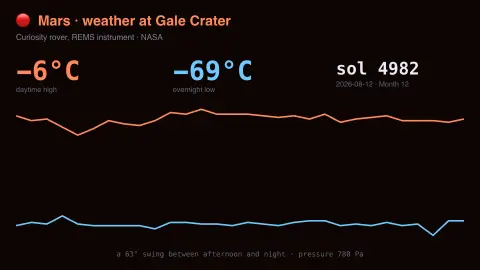
The Weather On Mars screensaver shows the latest daily weather from NASA's Curiosity rover in Gale Crater: daytime high, overnight low, atmospheric pressure and the Martian season, with the last month of readings charted. It runs in the browser with nothing to install; press ESC to exit.
Live preview
Press ESC to leave fullscreen. Settings are saved in your browser only.
How the The Weather On Mars screensaver works
The saver reads NASA's Mars weather feed for the Curiosity rover's REMS instrument.
No account and no key: the request goes straight from your browser, or from this site's own refreshed copy of the feed where the source does not permit browser access.
Values are drawn on a canvas that resizes with the window, so it works on a laptop or a wall display.
If the source is unreachable the saver says so on screen rather than showing stale numbers as though they were current.
Curiosity's weather station on Mars
NASA’s Curiosity rover landed in Gale Crater in 2012, carrying the Rover Environmental Monitoring Station, or REMS. The instrument was provided by Spain, with the Spanish Astrobiology Center leading the project and the Finnish Meteorological Institute contributing the pressure and humidity sensors. REMS measures air and ground temperature, atmospheric pressure, humidity, wind and ultraviolet radiation, which makes it the nearest thing to a weather report from another planet.
Mars is cold and thin-aired. The atmosphere is about 96 per cent carbon dioxide, and mean surface pressure is around 600 pascals, roughly 0.6 per cent of Earth’s at sea level. Seasons are real because Mars is tilted about 25 degrees, close to Earth’s 23.5, but they are longer because a Martian year lasts about 687 Earth days, and the orbit is noticeably elliptical, with an eccentricity of about 0.093.
A caution on interpretation: this is weather at one location, the rover’s, so it cannot describe the whole planet. The rover also does not sample constantly, and one of its two wind sensors was damaged during the landing in 2012, though the other still works. Data reach Earth with a delay, so the readings are historical rather than current.
A worked example
The current sol's high and low fill the top of the screen, with the sol number, Earth date and season beside them. Below, two lines chart the last month: highs in orange, lows in blue. The gap between them is the story — a summer afternoon a few degrees above freezing followed by a night at seventy below, because Mars has almost no atmosphere to hold the heat.
Settings & tips
- Accent and Background recolour the display without changing the data.
- Add it to a Multi-view grid to watch it alongside other live savers.
- Press ESC at any time to leave fullscreen.
Frequently asked questions
- What is a sol?
- A Martian day: 24 hours 39 minutes. Sol numbering counts from the rover's landing, which is why the sol number and the Earth date drift steadily apart.
- Why is the pressure so low?
- Because the Martian atmosphere is about one per cent as dense as Earth's. Around 700 pascals is normal there, against roughly 101,000 at sea level here — thin enough that liquid water would boil at ordinary temperatures.
- Is this real data?
- Yes. It comes from NASA's Mars weather feed for the Curiosity rover's REMS instrument. Nothing is invented or simulated, and if the source cannot be reached the saver reports that instead of drawing something plausible.
- Does it cost anything or need an account?
- No. Every screensaver here is free, runs in the browser and needs no sign-up. This one uses a public API that requires no key.
- Can it rain on Mars?
- Not as liquid water at the surface. The air is too cold and thin, though Mars has frost and thin water-ice clouds in its atmosphere.
- Why does a Martian year feel long?
- A Martian year is about 687 Earth days, roughly 1.88 Earth years, so each season lasts longer than its Earth counterpart.
- How thin is the Martian air?
- Mean surface pressure is about 600 pascals, roughly 0.6 per cent of Earth’s sea-level pressure, and it varies with altitude.