Marine Taxonomy Revised Screensaver
The Marine Taxonomy Revised screensaver shows records changed in the World Register of Marine Species, key-less. It's free, runs in your browser, and ESC exits.
Live preview
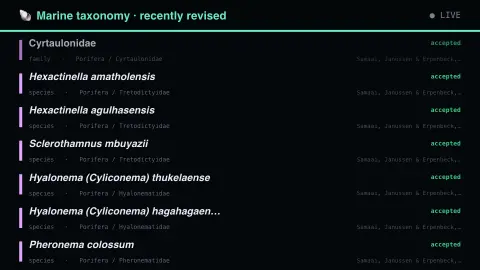
Press ESC to leave fullscreen. Settings are saved in your browser only.
How the Marine Taxonomy Revised screensaver works
The saver reads the source described above and draws it on a canvas — no account, no tracking.
Records changed in the World Register of Marine Species, key-less. Deliberately not billed as new discoveries: most entries are revisions, a name superseded by a new combination or a genus folded in as a junior synonym. That churn is the daily work of systematics.
It refreshes on a schedule, so what you see stays current.
Colours and any options can be changed in settings; nothing is stored beyond your own browser.
About the World Register of Marine Species
WoRMS, the World Register of Marine Species, aims to provide an authoritative and comprehensive list of the names of marine organisms, including synonyms, which also helps readers interpret older taxonomic literature. Its content is controlled by taxonomic and thematic experts who act as editors, rather than by database managers, and it is hosted by the Flanders Marine Institute (VLIZ) in Belgium.
A name in taxonomy is a hypothesis that changes with evidence. When genetic work shows that a species belongs in a different genus, the name takes a new combination and the older one becomes a synonym. The underlying system stores both accepted and unaccepted names and records the relationships between them, which is why one animal can have a long string of former names.
A record that appears on the board has been modified, not necessarily created. The edit might fix a spelling, add a distribution, link a source or change the classification. Marine biodiversity remains incompletely described, but a changed record is mostly curation, not discovery.
A worked example
Records changed in the World Register of Marine Species, key-less. Deliberately not billed as new discoveries: most entries are revisions, a name superseded by a new combination or a genus folded in as a junior synonym. That churn is the daily work of systematics.
Settings & tips
- Accent and Background recolour the display.
- Every value on screen comes from the live source — nothing is simulated.
- Press ESC to leave fullscreen.
Frequently asked questions
- Is this real data?
- Yes — it comes from the source named on this page and is refreshed on a schedule.
- Is a key needed?
- No. This source is fully key-less.
- Is it free?
- Yes — free, no download, in your browser.
- What does an unaccepted name mean?
- It is a name no longer treated as the valid one, for example because the species was reclassified or the name is a synonym. WoRMS keeps such names and links them to the accepted name.
- Who maintains the register?
- Taxonomic and thematic experts act as editors and data providers, and the register is hosted by the Flanders Marine Institute (VLIZ) in Belgium.
- Do all changes correspond to new species?
- No. A changed record can be a correction, a reclassification or extra information about an already described species.