A Parliament In Hebrew Screensaver
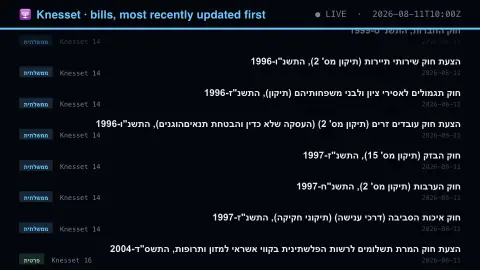
The A Parliament In Hebrew screensaver shows bills before the Israeli Knesset, key-less from its own OData service. Titles are Hebrew and are drawn right-to-left rather than transliterated. The service answers XML unless JSON is demanded on the query string, which is why this arrives by pipeline. It's free, runs in your browser, and ESC exits.
Live preview
Press ESC to leave fullscreen. Settings are saved in your browser only.
How the A Parliament In Hebrew screensaver works
The saver reads the source described above and draws it on a canvas — no account, no tracking.
Bills before the Israeli Knesset, key-less from its own OData service. Titles are Hebrew and are drawn right-to-left rather than transliterated. The service answers XML unless JSON is demanded on the query string, which is why this arrives by pipeline.
It refreshes on a schedule, so what you see stays current.
Colours can be changed in settings; nothing is stored beyond your own browser.
Following bills in the Knesset
The Knesset is Israel’s unicameral parliament, with 120 members. Its open-data service exposes parliamentary records, including bills, committees and members, through an OData interface, so anyone can query the record directly rather than scraping web pages.
Under the Knesset’s Rules of Procedure a bill is debated in three readings, and a private member’s bill first needs a preliminary reading, where the plenum votes on whether it goes to committee. Government bills go straight to a first reading. Some bills are sponsored by a committee, which is allowed only on certain subjects such as Basic Laws, the Knesset and its members, elections and the State Comptroller. After the first reading a bill goes to committee, which can amend it, before the second and third readings, and a law is adopted in the third reading.
Titles in the feed are the official Hebrew text, which is why the display is drawn right to left rather than transliterated. Many private bills do not progress past the early stages, and a record appearing in the feed does not show its prospects. For the meaning of a bill, the full text and explanatory notes are the authority.
A worked example
Bills before the Israeli Knesset, key-less from its own OData service. Titles are Hebrew and are drawn right-to-left rather than transliterated. The service answers XML unless JSON is demanded on the query string, which is why this arrives by pipeline.
Settings & tips
- Accent and Background recolour the display.
- Every value on screen comes from the live source — nothing is simulated.
- Press ESC to leave fullscreen.
Frequently asked questions
- Is this real data?
- Yes — it comes from the source named on this page and is refreshed on a schedule.
- Is a key needed?
- No. This source is fully key-less.
- Is it free?
- Yes, and it runs entirely in your browser.
- What is a private bill?
- A bill proposed by an individual member of the Knesset rather than the government. It must pass a preliminary reading before it can be sent to committee and on to a first reading.
- How many readings does a bill have?
- Three. A bill is debated at first, second and third readings, with committee work between them, and a law is adopted in the third reading.