Japan, Shaking Screensaver
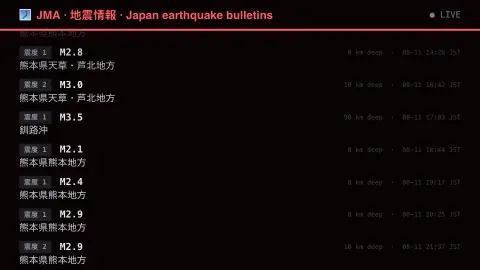
The Japan, Shaking screensaver shows earthquake bulletins from the Japan Meteorological Agency, key-less. Led by shindo, the intensity felt at the surface: a distant magnitude 6 can register a 2, and a shallow magnitude 4 next door can register a 4. It's free, runs in your browser, and ESC exits.
Live preview
Press ESC to leave fullscreen. Settings are saved in your browser only.
How the Japan, Shaking screensaver works
The saver reads the source described above and draws it on a canvas — no account, no tracking.
Earthquake bulletins from the Japan Meteorological Agency, key-less. Led by shindo, the intensity felt at the surface: a distant magnitude 6 can register a 2, and a shallow magnitude 4 next door can register a 4.
It refreshes on a schedule, so what you see stays current.
Colours and any options can be changed in settings; nothing is stored beyond your own browser.
What shindo measures
The Japan Meteorological Agency publishes earthquake information for Japan. Its measure of felt shaking is the shindo scale, which has ten levels: 0 to 4, then 5-lower, 5-upper, 6-lower, 6-upper and 7. Since April 1996 the JMA has dropped observer-based estimates and moved to instruments; intensity is calculated from acceleration recorded by seismic intensity meters, and an instrumental value of 6.5 or higher is classed as 7.
Shindo is not magnitude. Magnitude describes the earthquake as a whole, while shindo describes shaking at one place, and it depends on the distance and depth of the source, the local ground and the event’s size. A distant earthquake can therefore register low shindo and a shallow, nearby one can register high, and a single event produces many shindo values at once.
Bulletins give the region of the epicentre, a magnitude and the maximum shindo observed. The JMA publishes its own magnitude, separate from other agencies’ figures, so numbers for the same event can differ slightly between sources. Times are in Japan Standard Time, nine hours ahead of UTC.
A worked example
Earthquake bulletins from the Japan Meteorological Agency, key-less. Led by shindo, the intensity felt at the surface: a distant magnitude 6 can register a 2, and a shallow magnitude 4 next door can register a 4.
Settings & tips
- Accent and Background recolour the display.
- Every value on screen comes from the live source — nothing is simulated.
- Press ESC to leave fullscreen.
Frequently asked questions
- Is this real data?
- Yes — it comes from the source named on this page and is refreshed on a schedule.
- Is a key needed?
- No. This source is fully key-less.
- Is it free?
- Yes, and it runs entirely in your browser.
- Is shindo the same as the Mercalli scale?
- No. Both describe shaking at a place, but shindo is a separate scale defined by the JMA and measured by instruments, so the two are not directly interchangeable.
- Why can a small earthquake have a high shindo?
- Shindo measures shaking at a site, not the energy released. A shallow earthquake close to a site can shake it strongly even if the magnitude is modest.
- What time zone are the bulletins in?
- Japan Standard Time, which is nine hours ahead of UTC.