IPv4 Address Allocation Screensaver
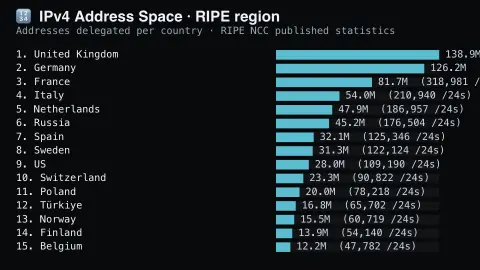
The IPv4 Address Allocation screensaver shows how much IPv4 address space is delegated to each country in the RIPE region, from RIPE NCC's key-less published statistics. IPv4 space is finite and essentially fully allocated, so totals now move only through transfers. It's free, runs in your browser, and ESC exits.
Live preview
Press ESC to leave fullscreen. Settings are saved in your browser only.
How the IPv4 Address Allocation screensaver works
The background pipeline reads this from RIPE NCC published statistics and saves a snapshot the saver loads.
How much IPv4 address space is delegated to each country in the RIPE region, from RIPE NCC's key-less published statistics.
It refreshes on a schedule, so what you see stays current.
Colours can be changed in settings; nothing is stored beyond your own browser.
Why IPv4 addresses ran out
An IPv4 address is a 32-bit number, usually written as four numbers separated by dots, which allows about 4.3 billion unique addresses. That seemed ample when the protocol was designed, but the supply was outgrown by the spread of computers, phones and connected devices. The last unreserved blocks in the central IANA pool were handed to the regional registries on 31 January 2011, and regional registries have since run low or out: RIPE NCC began allocating from its last /8 in September 2012.
Address space is handed out by regional internet registries. RIPE NCC serves Europe, the Middle East and parts of Central Asia, and publishes statistics on the blocks it has delegated to organisations in each country. The figures count addresses held by organisations registered in a country, which does not always match where the devices are physically used, since companies can hold space that is used elsewhere.
Holdings now change mainly through transfers between organisations, so totals shift only slightly. Techniques such as carrier-grade NAT let many users share a public address, and the successor protocol IPv6 provides a vastly larger space. A country's IPv4 total is therefore a record of allocation, not a measure of how many people are online.
A worked example
How much IPv4 address space is delegated to each country in the RIPE region, from RIPE NCC's key-less published statistics. IPv4 space is finite and essentially fully allocated, so totals now move only through transfers.
Settings & tips
- Accent and Background recolour the display.
- Run
automation/run.py ipv4allocationto refresh the feed. - Press ESC to leave fullscreen.
Frequently asked questions
- Is this real data?
- Yes — it comes from RIPE NCC published statistics and is refreshed on a schedule.
- Why don't these numbers grow?
- IPv4 space is finite and essentially fully allocated, so country totals now change through transfers between holders rather than fresh allocation.
- Is a key needed?
- No. This source is fully key-less.
- Is it free?
- Yes — free, no download, in your browser.
- Why can't new IPv4 addresses be created?
- The address length is fixed at 32 bits, so the total supply is fixed. More space requires moving to IPv6, which uses 128-bit addresses.
- Does a larger address total mean more internet users?
- Not necessarily. Allocation reflects how organisations obtained space, and many users can share a single address through NAT.
- What is a regional internet registry?
- It is an organisation that distributes internet number resources in a region and keeps the records. RIPE NCC is the registry for Europe, the Middle East and parts of Central Asia.