Internet Routing Status Screensaver
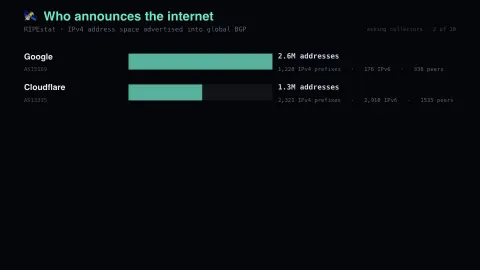
The Internet Routing Status screensaver shows how much address space the biggest networks actually advertise into the global routing table, from RIPE's key-less RIPEstat. It's free, runs in your browser, and ESC exits.
Live preview
Press ESC to leave fullscreen. Settings are saved in your browser only.
How the Internet Routing Status screensaver works
The saver reads the source described above and draws it on a canvas — no account, no tracking.
How much address space the biggest networks actually advertise into the global routing table, from RIPE's key-less RIPEstat. Every network has to announce its prefixes via BGP for the rest of the world to reach it; this is that announcement, seen from RIPE's collectors.
It refreshes on a schedule, so what you see stays current.
Colours and any options can be changed in settings; nothing is stored beyond your own browser.
RIPEstat, BGP and the global routing table
RIPEstat is a public data service run by the RIPE NCC, the regional internet registry for Europe, the Middle East and parts of Central Asia. Its Data API is the single data source behind both the RIPEstat web interface at stat.ripe.net and its widgets, and it offers routing, registration (such as Whois) and geolocation data calls.
The measurement shown here concerns BGP, the Border Gateway Protocol, by which each autonomous system (a network identified by an AS number) tells its neighbours which blocks of IP addresses it can reach. The RIPE NCC’s Routing Information Service, RIS, runs route collectors that record those announcements from many vantage points, and RIPEstat exposes an announced-prefixes call for a given AS.
Several caveats apply. Announced is not the same as allocated: a network may hold addresses it does not advertise, and may advertise blocks that overlap or are subdivided to steer traffic. The total therefore depends on how overlaps are counted, and the view depends on which collectors saw the announcements. IPv4 and IPv6 address spaces are different sizes, so figures between them are not directly comparable.
A worked example
How much address space the biggest networks actually advertise into the global routing table, from RIPE's key-less RIPEstat. Every network has to announce its prefixes via BGP for the rest of the world to reach it; this is that announcement, seen from RIPE's collectors.
Settings & tips
- Accent and Background recolour the display.
- Every number on screen comes from the live source — nothing is simulated.
- Press ESC to leave fullscreen.
Frequently asked questions
- Is this real data?
- Yes — it comes from the source named on this page and is refreshed on a schedule.
- Is a key needed?
- No. This source is fully key-less.
- Is it free?
- Yes — free, no download, in your browser.
- What is an autonomous system?
- A network, or group of networks, under one administrative policy that is identified by an AS number and exchanges routes with others using BGP.
- Does a bigger bar mean a bigger network in traffic terms?
- No. It reflects address space announced, which says nothing about how much data actually flows.
- Why can the same network appear differently over time?
- Operators change which prefixes they announce, split or aggregate them, and what is seen depends on the collectors’ vantage points.