The Encyclopedia Of Integers Screensaver
The The Encyclopedia Of Integers screensaver shows entries from the On-Line Encyclopedia of Integer Sequences, gathered key-less by the pipeline. It's free, runs in your browser, and ESC exits.
Live preview
Press ESC to leave fullscreen. Settings are saved in your browser only.
How the The Encyclopedia Of Integers screensaver works
The saver reads the source described above and draws it on a canvas — no account, no tracking.
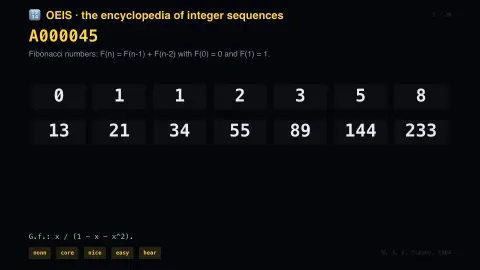
Entries from the On-Line Encyclopedia of Integer Sequences, gathered key-less by the pipeline. Neil Sloane started collecting these on punched cards in 1964; each card here shows the opening terms and the formula or recurrence that generates them.
It refreshes on a schedule, so what you see stays current.
Colours and any options can be changed in settings; nothing is stored beyond your own browser.
Inside the On-Line Encyclopedia of Integer Sequences
The OEIS is a catalogue of integer sequences: lists such as 0, 1, 1, 2, 3, 5 that follow some rule. Neil Sloane started it in 1964 as a graduate student at Cornell, and it grew through the 1973 book A Handbook of Integer Sequences and the 1995 Encyclopedia of Integer Sequences before going online in 1996. It is now owned and maintained by the OEIS Foundation, a nonprofit Sloane set up, and any registered user can propose a new sequence, which editors review before it is added.
Every entry has an A-number. A000045 is the Fibonacci numbers and A000040 the primes, and low numbers tend to be the classics. Each card also gives a name or definition, the first terms, and often a formula or generating function, such as G.f.: x / (1 - x - x^2) for Fibonacci. Keywords like nonn (non-negative terms), core and nice are editorial tags describing how the sequence behaves or how fundamental it is.
The practical use is lookup: if a calculation produces a run of terms, searching them can reveal that others have met the same sequence, with references and comments attached. Showing a few terms is a window into the entry, not a substitute for its references and comments.
A worked example
Entries from the On-Line Encyclopedia of Integer Sequences, gathered key-less by the pipeline. Neil Sloane started collecting these on punched cards in 1964; each card here shows the opening terms and the formula or recurrence that generates them.
Settings & tips
- Accent and Background recolour the display.
- Every value on screen comes from the live source — nothing is simulated.
- Press ESC to leave fullscreen.
Frequently asked questions
- Is this real data?
- Yes — it comes from the source named on this page and is refreshed on a schedule.
- Is a key needed?
- No. This source is fully key-less.
- Is it free?
- Yes, and it runs entirely in your browser.
- What do the keywords on a card mean?
- They are editorial labels: nonn says all displayed terms are non-negative, easy that it is easy to produce terms, core that it is an important sequence, and nice that it is an exceptionally nice one.
- Who decides what gets an A-number?
- Any registered user can submit a sequence, and editors review submissions before they are added permanently.
- When did the OEIS go online?
- Neil Sloane launched it on the internet in 1996, after starting the collection in 1964. A new version of the system launched in November 2010.