Hackage Uploads Screensaver
The Hackage Uploads screensaver shows haskell packages as they are published to Hackage, gathered key-less by the pipeline. It's free, runs in your browser, and ESC exits.
Live preview
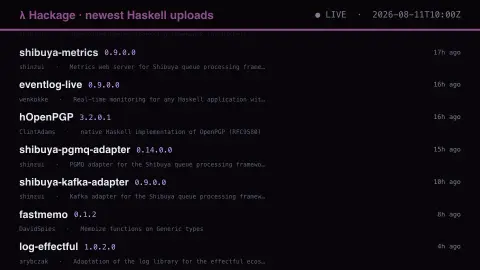
Press ESC to leave fullscreen. Settings are saved in your browser only.
How the Hackage Uploads screensaver works
The saver reads the source described above and draws it on a canvas — no account, no tracking.
Haskell packages as they are published to Hackage, gathered key-less by the pipeline. Every upload carries its version, so the board doubles as a view of how the ecosystem versions itself: a stream of 0.1.0.0 first releases beside long-lived libraries deep into point revisions.
It refreshes on a schedule, so what you see stays current.
Colours and any options can be changed in settings; nothing is stored beyond your own browser.
Hackage and the Haskell package ecosystem
Hackage is the Haskell community’s central archive of open source packages, online since January 2007. Developers describe a library or program in a Cabal file, which names the package, its version, its authors and the other packages it depends on, then upload it as a source tarball made with Cabal’s sdist command. Tools such as cabal-install download and install packages from it, and uploading requires a registered account.
Versions on Hackage follow the Package Versioning Policy (PVP), which differs from the semantic versioning common elsewhere. In a version A.B.C, the first two components together form the major version, and a change to those signals a possibly breaking interface; C is the minor version, raised for backwards-compatible additions. That is why a package can jump from 0.4 to 2.0 and still be a deliberate, ordinary release.
Each package’s Cabal file also carries a one-line synopsis, written freely by the author for package listings. Hackage does not allow packages to be deleted, so authors are encouraged to test new versions as package candidates first. An upload says only that a release exists, not that it builds on every compiler version.
A worked example
Haskell packages as they are published to Hackage, gathered key-less by the pipeline. Every upload carries its version, so the board doubles as a view of how the ecosystem versions itself: a stream of 0.1.0.0 first releases beside long-lived libraries deep into point revisions.
Settings & tips
- Accent and Background recolour the display.
- Every value on screen comes from the live source — nothing is simulated.
- Press ESC to leave fullscreen.
Frequently asked questions
- Is this real data?
- Yes — it comes from the source named on this page and is refreshed on a schedule.
- Is a key needed?
- No. This source is fully key-less.
- Is it free?
- Yes — free, no download, in your browser.
- Why do version numbers look different from other languages?
- Hackage packages follow the Haskell Package Versioning Policy, whose major version has two components, so a change such as 0.4 to 0.5 can signal breaking API changes.
- Who can upload to Hackage?
- People with a registered Hackage account can upload Cabal packages as source tarballs.
- What is the synopsis shown under each name?
- A one-line summary taken from the package’s own Cabal file, written by the author.