Go Module Index Screensaver
The Go Module Index screensaver shows go module versions as the public module proxy sees them, gathered key-less by the pipeline. It's free, runs in your browser, and ESC exits.
Live preview
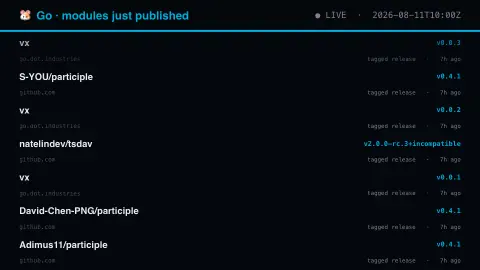
Press ESC to leave fullscreen. Settings are saved in your browser only.
How the Go Module Index screensaver works
The saver reads the source described above and draws it on a canvas — no account, no tracking.
Go module versions as the public module proxy sees them, gathered key-less by the pipeline. Go has no central registry: modules are repositories, and the index is simply the log of what the proxy has fetched, which is why paths read as URLs.
It refreshes on a schedule, so what you see stays current.
Colours and any options can be changed in settings; nothing is stored beyond your own browser.
The Go module proxy and its index
Go has no central package registry in the way that npm or PyPI does. A Go module is identified by a path that usually looks like a repository address, and the toolchain can fetch it directly from version control or through a module proxy. Google runs a public module mirror at proxy.golang.org, a checksum database at sum.golang.org that authenticates module content, and an index at index.golang.org.
The index is a feed of module versions that became available through the proxy, in chronological order, with each entry giving the module path, the version and the time the proxy first cached it. That feed is what this saver reads, and it is why paths here look like URLs, often with github.com at the front. An entry means a version was fetched through the proxy; it does not mean the author announced a release.
Many versions look odd: v0.0.0- followed by a timestamp and a commit hash is a pseudo-version, which Go uses to name a specific revision in a repository, for example when a project is pinned to a commit that has no tag. The timestamp is the UTC commit time and the hash is a 12-character prefix of the commit. The list can include forks, test repositories and experiments, so seeing a path here is not an endorsement or a quality signal.
A worked example
Go module versions as the public module proxy sees them, gathered key-less by the pipeline. Go has no central registry: modules are repositories, and the index is simply the log of what the proxy has fetched, which is why paths read as URLs.
Settings & tips
- Accent and Background recolour the display.
- Every value on screen comes from the live source — nothing is simulated.
- Press ESC to leave fullscreen.
Frequently asked questions
- Is this real data?
- Yes — it comes from the source named on this page and is refreshed on a schedule.
- Is a key needed?
- No. This source is fully key-less.
- Is it free?
- Yes — free, no download, in your browser.
- What is the odd version string with a date and hash?
- A pseudo-version. Go builds it from a base version, the UTC commit timestamp and a 12-character commit hash prefix, so a build can pin an exact revision of a repository that has no suitable tag.
- Does this list every Go package?
- Only versions that have passed through the proxy. By default the index lists versions the proxy has cached, so code never fetched through it does not appear, and the entries are versions rather than unique modules.