Tissue By Tissue Screensaver
The Tissue By Tissue screensaver shows sample counts per human tissue from the GTEx project, key-less. GTEx exists because the same genome reads out differently in liver than in cortex, and measuring that needed donated tissue from many bodies — so the uneven bars are the practical shape of that effort rather than a biological fact. It's free, runs in your browser, and ESC exits.
Live preview
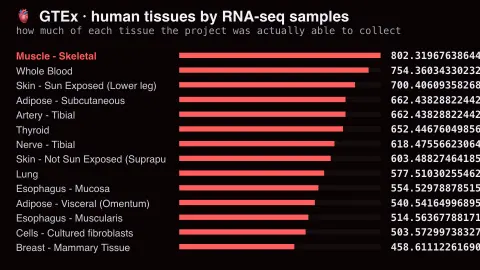
Press ESC to leave fullscreen. Settings are saved in your browser only.
How the Tissue By Tissue screensaver works
The saver reads the source described above and draws it on a canvas — no account, no tracking.
Sample counts per human tissue from the GTEx project, key-less. GTEx exists because the same genome reads out differently in liver than in cortex, and measuring that needed donated tissue from many bodies — so the uneven bars are the practical shape of that effort rather than a biological fact.
It refreshes on a schedule, so what you see stays current.
Colours can be changed in settings; nothing is stored beyond your own browser.
What the GTEx project studies
GTEx, the Genotype-Tissue Expression project, was an NIH Common Fund effort, supported from 2010 to 2019, to study how inherited genetic variation affects gene activity in non-diseased human tissues. Samples were collected from up to 53 tissue sites in nearly 1,000 deceased donors, found through low post-mortem-interval autopsy or organ and tissue transplantation settings. RNA was measured in each sample to see which genes were active, alongside the donors' genetic variants.
The project reports counts of samples per tissue, such as skeletal muscle, whole blood, subcutaneous fat, the many brain regions and the tibial artery. Counts differ between tissues because not every tissue was available from every donor. Larger sample numbers give more statistical power to find links between a variant and expression. Data are shared through dbGaP and the GTEx Portal.
The figures describe the research resource, not how many tissues exist in the body or how much tissue was taken from any one person. One donor can contribute several tissues, so a sample count is not a count of people. The display reports sample counts only and does not present health findings.
A worked example
Sample counts per human tissue from the GTEx project, key-less. GTEx exists because the same genome reads out differently in liver than in cortex, and measuring that needed donated tissue from many bodies — so the uneven bars are the practical shape of that effort rather than a biological fact.
Settings & tips
- Accent and Background recolour the display.
- Every value on screen comes from the live source — nothing is simulated.
- Press ESC to leave fullscreen.
Frequently asked questions
- Is this real data?
- Yes — it comes from the source named on this page and is refreshed on a schedule.
- Is a key needed?
- No. This source is fully key-less.
- Is it free?
- Yes, and it runs entirely in your browser.
- What does a sample count mean here?
- It is the number of tissue samples in the project's dataset for that tissue, not the number of people, since one donor can contribute several tissues.
- Where did the donors come from?
- GTEx collected tissue from deceased donors, found through low post-mortem-interval autopsy or organ and tissue transplantation settings, to keep RNA quality high.
- Does the data include living patients?
- The core GTEx collection comes from deceased donors, so it reflects postmortem tissue rather than samples from living patients.