Cancer Genomes, Shared Screensaver
The Cancer Genomes, Shared screensaver shows public cancer genomics studies from cBioPortal, key-less. Each row is a cohort whose tumours were sequenced and then released for anyone to re-analyse, which is why the citation matters as much as the title: someone published the paper, then gave away the data underneath it. It's free, runs in your browser, and ESC exits.
Live preview
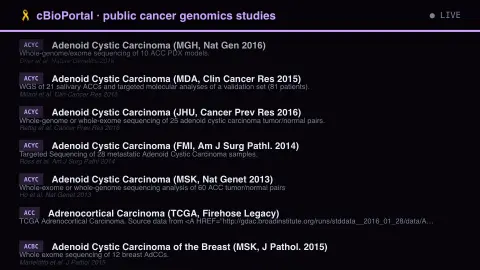
Press ESC to leave fullscreen. Settings are saved in your browser only.
How the Cancer Genomes, Shared screensaver works
The saver reads the source described above and draws it on a canvas — no account, no tracking.
Public cancer genomics studies from cBioPortal, key-less. Each row is a cohort whose tumours were sequenced and then released for anyone to re-analyse, which is why the citation matters as much as the title: someone published the paper, then gave away the data underneath it.
It refreshes on a schedule, so what you see stays current.
Colours can be changed in settings; nothing is stored beyond your own browser.
What cBioPortal makes possible
cBioPortal for Cancer Genomics is an open-source platform originally developed at Memorial Sloan Kettering Cancer Center. It is now developed and maintained by a multi-institution team that includes Dana-Farber Cancer Institute, Princess Margaret Cancer Centre, Children’s Hospital of Philadelphia, The Hyve and Bilkent University. It lets researchers interactively explore multidimensional cancer genomics data, such as mutations, copy-number changes and gene expression, alongside clinical data.
A study in cBioPortal is a cohort: a set of patients whose tumour samples were profiled in a published project or a consortium such as The Cancer Genome Atlas. Each study lists its size in samples, the cancer type and a reference to its publication, which is why the paper citation is shown.
It is research infrastructure and not a diagnostic tool. A study’s sample count says nothing about how representative the cohort is of all patients, and findings from one cohort may not hold in another. Studies are added as groups release data, so what appears on the board reflects release timing as much as the pace of research.
A worked example
Public cancer genomics studies from cBioPortal, key-less. Each row is a cohort whose tumours were sequenced and then released for anyone to re-analyse, which is why the citation matters as much as the title: someone published the paper, then gave away the data underneath it.
Settings & tips
- Accent and Background recolour the display.
- Every value on screen comes from the live source — nothing is simulated.
- Press ESC to leave fullscreen.
Frequently asked questions
- Is this real data?
- Yes — it comes from the source named on this page and is refreshed on a schedule.
- Is a key needed?
- No. This source is fully key-less.
- Is it free?
- Yes, and it runs entirely in your browser.
- What is a study in cBioPortal?
- A dataset from a cohort of tumour samples, usually linked to a publication or consortium, with molecular and clinical data.
- Who develops cBioPortal?
- It was originally developed at Memorial Sloan Kettering Cancer Center and is now developed by a multi-institution team, as open-source software.
- Can this be used to understand my own diagnosis?
- No. It is a research resource for cohorts, not guidance for individual care, which belongs with a clinician.