GitHub New & Starred Repos Screensaver
The GitHub New & Starred Repos screensaver streams real repositories created in the last week, ranked by stars as they're reported. It is free, runs in your browser, and ESC exits.
Live preview
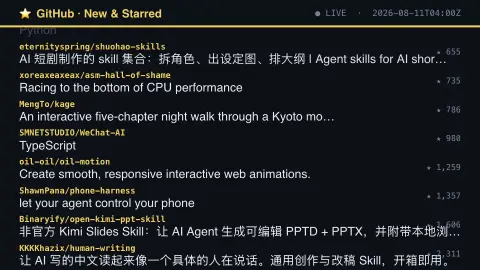
Press ESC to leave fullscreen. Settings are saved in your browser only.
How the GitHub New & Starred Repos screensaver works
The background pipeline polls GitHub — GitHub's own public Search API — every few minutes for new records.
Each new item eases up into its slot at the bottom of the list as it arrives.
A header shows a live/connecting indicator and the last update time.
No key is required for this key-less public endpoint.
Reading GitHub stars on week-old repositories
GitHub lets anyone star a repository. GitHub says starring is a way to find a repository again later and to show appreciation to its maintainer, and star counts feed into its repository rankings. The REST search endpoint for repositories accepts sort=stars, and a created: qualifier takes a date in YYYY-MM-DD form, with greater-than and range forms. This screensaver asks for projects created within the last seven days and orders them by stars, so every row is a project that did not exist a week ago yet has already attracted attention.
A star is a weak signal. It means someone wanted to remember or support the project, not that they installed or reviewed it. A repository with a very high count after a few days is often a well-known author's new release, a curated list or a collection of learning resources, rather than mature software. Star counts can also be driven by publicity or inflated deliberately, so they say little about quality.
A repository's creation date is when the repository was made on GitHub, which can differ from when the code was written; a long-developed project moved to a new repository will appear brand new. Search results are capped at 1,000 per query, and unauthenticated search requests are limited to 10 per minute, so the board shows a slice of the week's repositories rather than a full census. Descriptions are whatever the owner typed and may be missing or promotional.
A worked example
A real recent item scrolls into view with its details, then eases upward as newer ones arrive behind it.
Settings & tips
- Each repo shows its real star count, language and description.
- Accent recolours the header and highlights.
- Rankings refresh as the pipeline re-polls GitHub's Search API.
Frequently asked questions
- Is this real data?
- Yes — it's read live from GitHub, GitHub's own public Search API.
- Is a key needed?
- No. This is a fully key-less public API.
- How often does it refresh?
- The pipeline polls for new records every few minutes.
- Is it free?
- Yes — free, no download, in your browser.
- Does a high star count mean a project is good?
- Not by itself. Stars are used to bookmark a repository and show appreciation, and they can spike from publicity or be gamed, so they say little about quality or maintenance.
- Why do some repositories look like lists rather than software?
- Curated lists and learning collections are easy to appreciate and share, so they can gather stars quickly and often rank above real applications.
- What counts as new here?
- Repositories created on GitHub within roughly the last week. A project migrated from elsewhere can qualify even if its code is older.