Geomagnetic Storm Index Screensaver
The Geomagnetic Storm Index screensaver shows the Kyoto Dst index, which measures how much Earth's magnetic field is being disturbed by the solar wind. It goes negative during a storm — the more negative, the stronger the disturbance. It's free, runs in your browser, and ESC exits.
Live preview
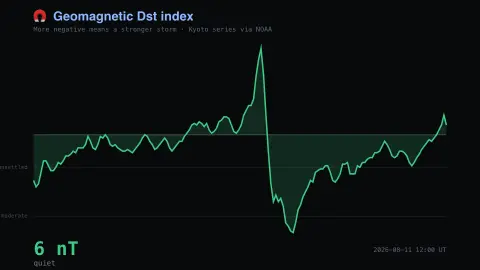
Press ESC to leave fullscreen. Settings are saved in your browser only.
How the Geomagnetic Storm Index screensaver works
The saver reads the Kyoto Dst series via NOAA directly in your browser — no key and no account.
The Kyoto Dst index, which measures how much Earth's magnetic field is being disturbed by the solar wind.
It refreshes on a schedule, so what you see stays current.
Colours can be changed in settings; nothing is stored beyond your own browser.
The Dst index and Earth's ring current
The Dst, or disturbance storm time, index estimates how much the horizontal component of Earth's magnetic field has been depressed worldwide. It is calculated from magnetometers at four low-latitude observatories spread around the globe (Hermanus, Kakioka, Honolulu and San Juan), and the World Data Center for Geomagnetism in Kyoto produces it.
The unit is the nanotesla, a billionth of a tesla. Quiet conditions sit near zero. During a geomagnetic storm, charged particles build up in the ring current circling Earth, and its magnetic effect weakens the field measured on the ground, so the index falls below zero. Researchers use rough thresholds, with readings below about minus 50 often called a moderate storm, below minus 100 intense, and below roughly minus 250 a super storm, though the exact cut-offs vary between authors.
Final values are determined only after each calendar year, because the baseline depends on annual means, so values published soon after the fact are provisional and the recent end of the curve can change. Dst is a low-latitude average and does not capture the intense local effects near the poles, where auroras appear; those are tracked by other indices. It describes the magnetic field, not any damage to technology on its own.
A worked example
The Kyoto Dst index, which measures how much Earth's magnetic field is being disturbed by the solar wind. It goes negative during a storm — the more negative, the stronger the disturbance.
Settings & tips
- Accent and Background recolour the display.
- Data comes straight from the Kyoto Dst series via NOAA in your browser.
- Press ESC to leave fullscreen.
Frequently asked questions
- Is this real data?
- Yes — it comes from the Kyoto Dst series via NOAA and is refreshed on a schedule.
- Why does it go down during a storm?
- Dst measures how much the ring current is suppressing Earth's surface magnetic field. A stronger storm suppresses it further, so the number falls further below zero.
- Is a key needed?
- No. This source is fully key-less.
- Is it free?
- Yes — free, no download, in your browser.
- What are the units of the Dst index?
- Nanotesla. Zero means quiet, and storms push it negative.
- Does a deep Dst mean there will be strong auroras?
- Not directly. Aurora activity is driven by high-latitude processes that Dst, measured near the equator, does not fully capture.
- Are the recent values final?
- No. Final values are fixed only after the calendar year ends, so recent values are provisional and may be adjusted.