Frost Growth Screensaver
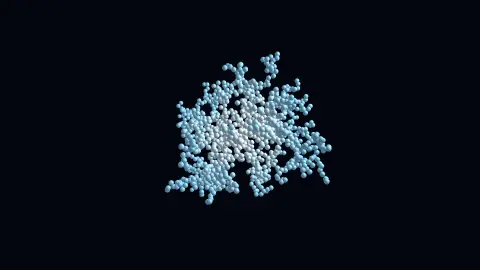
The Frost Growth screensaver runs diffusion-limited aggregation in three dimensions: particles wander at random until they touch the cluster, then stick there permanently. It runs in the browser with nothing to install; press ESC to exit.
Live preview
Press ESC to leave fullscreen. Settings are saved in your browser only.
How the Frost Growth screensaver works
The saver renders with three.js on your GPU. The library is vendored into this site rather than fetched from a CDN, and loads only when a 3D screensaver actually runs.
It reads nothing external — the growth is simulated in the browser.
The scene resizes with the window and releases its WebGL context when the saver stops, so shuffle mode and Multi-view can cycle 3D savers without exhausting the browser's context limit.
If WebGL is unavailable the saver says so on screen rather than showing an empty black box.
Diffusion-limited aggregation in three dimensions
Diffusion-limited aggregation, or DLA, was proposed by T. A. Witten and L. M. Sander in 1981 in Physical Review Letters, in a paper titled "Diffusion-Limited Aggregation, a Kinetic Critical Phenomenon". A seed sits at the centre. A new particle starts far away and takes a random walk, and when it first touches the cluster it sticks for good. Repeating this thousands of times builds a branching structure.
The shape emerges from a screening effect: an outer tip is more likely to be hit by a wandering particle than a point deep inside a gap, so tips grow faster and gaps stay empty. The result is a fractal, with a dimension below that of the space it lives in. Free-particle simulations give about 1.71 in two dimensions, and off-lattice studies in three dimensions report about 2.50, so the cluster fills space far more sparsely than a solid ball.
DLA-like patterns are seen in systems such as electrodeposition, Hele-Shaw flow, mineral deposits and dielectric breakdown. The three-dimensional version shown here is a computational model and not a simulation of any specific physical material.
A worked example
Each particle is launched from a sphere just outside the cluster and takes a random walk until it contacts something. Because a wandering particle is far more likely to meet a protruding tip than to find its way into a sheltered crevice, tips grow faster and the structure branches. Nothing decides that shape — it follows from the outside being easier to reach than the inside.
Settings & tips
- Accent and Background recolour the scene; Speed changes the pace of the motion and the camera.
- Add it to a Multi-view grid, though 3D savers are heavier than 2D ones and a few per screen is plenty.
- Press ESC at any time to leave fullscreen.
Frequently asked questions
- Where does this happen in nature?
- Frost on a window, mineral dendrites in rock, copper deposited in electroplating, and the branching of a lightning channel. Any process where something arrives by random motion and sticks on contact produces this family of shapes.
- Why does it grow slowly?
- Because each particle must genuinely random-walk until it makes contact, and most of that walking goes nowhere. Speeding it up by placing particles directly would produce a different, less realistic shape.
- Does this need a special browser or plugin?
- No. It uses WebGL, which every current desktop and mobile browser supports. Nothing is installed and no plugin is required.
- Does it cost anything or need an account?
- No. Every screensaver here is free, runs in the browser and needs no sign-up.
- What is the fractal dimension of a DLA cluster?
- Roughly 1.71 in two dimensions and about 2.5 in three. This means the cluster fills space much more sparsely than a solid ball would.
- Who invented diffusion-limited aggregation?
- Thomas Witten and Leonard Sander, in a 1981 Physical Review Letters paper.