Flying Toasters, With Depth Screensaver
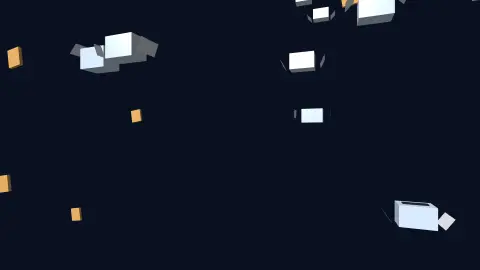
The Flying Toasters, With Depth screensaver rebuilds the After Dark flock in three dimensions: chrome toasters with wings that hinge, flying from upper right to lower left, at genuinely different distances from the camera. It runs in the browser with nothing to install; press ESC to exit.
Live preview
Press ESC to leave fullscreen. Settings are saved in your browser only.
How the Flying Toasters, With Depth screensaver works
The saver renders with three.js on your GPU. The library is vendored into this site rather than fetched from a CDN, and is loaded only when a 3D screensaver actually runs.
It reads nothing external — modelled and rendered in the browser with three.js.
The scene resizes with the window and releases its WebGL context when the saver stops, so shuffle mode and Multi-view can cycle 3D savers without exhausting the browser's context limit.
If WebGL is unavailable the saver says so on screen rather than showing an empty black box.
Winged toasters and the screensaver era
Flying Toasters was the best-known module of After Dark, a screensaver collection developed by Berkeley Systems and first released for the Apple Macintosh in 1989, with a Windows version following in 1991. It showed 1940s-style chrome toasters with bird-like wings flying across the screen alongside slices of toast. A slider let users adjust how dark the toast was, and later versions added music, bagels, pastries and baby toasters.
The original was a two-dimensional animation. A 3D version replaces flat images with geometry that a graphics card draws from any angle, which allows true perspective. Objects close to the viewer cover more of the screen and appear to cross it faster than distant ones, an effect known as motion parallax.
That is why near toasters race while far ones drift, even when they travel at the same real speed. It is one of the cues the eye uses to read depth on a flat display. The toasters became famous enough to draw a lawsuit: in 1994 the band Jefferson Airplane sued over the winged toasters on its 1973 album cover, but the case was dismissed. This rendering is a modern homage, not a copy of the original artwork.
A worked example
Twenty-six objects are spread through a slab of depth about 22 units thick. Because they are at real distances, the near ones cross the frame in about a second while the far ones drift slowly, and the flock reads as a volume rather than a pattern. Wings rotate on a hinge at the body rather than swapping between drawn frames, and roughly a fifth of the flock is toast, which tumbles instead of flapping.
Settings & tips
- Accent and Background recolour the scene; Speed changes the pace of both the motion and the camera.
- Add it to a Multi-view grid, though 3D savers are heavier than the 2D ones and a few per screen is plenty.
- Press ESC at any time to leave fullscreen.
Frequently asked questions
- Is this the original artwork?
- No. The toasters are modelled from simple solids — a chrome body, a dark slot, hinged wings — rather than copying After Dark's sprites. It is a tribute to a famous piece of software, not a reproduction of its assets.
- Why does the flock look uneven?
- Because it is. Each object has its own speed and starting distance, so they spread out rather than moving in formation. A regular grid of toasters would look like wallpaper.
- Does this need a special browser or plugin?
- No. It uses WebGL, which every current desktop and mobile browser supports. Nothing is installed and no plugin is required.
- Does it cost anything or need an account?
- No. Every screensaver here is free, runs in the browser and needs no sign-up.
- Where do Flying Toasters come from?
- They were a module in After Dark, a screensaver collection developed by Berkeley Systems and first released for the Apple Macintosh in 1989, with a Windows release in 1991.
- What is parallax?
- It is the apparent shift in position of nearby objects compared with distant ones when the viewpoint moves. Near things sweep past quickly while far ones barely change, which is a cue to depth.
- Did the flying toasters cause a lawsuit?
- Yes. In 1994 the rock group Jefferson Airplane sued, claiming the toasters copied the winged toasters on the cover of its 1973 album Thirty Seconds Over Winterland. The case was dismissed because the group had not registered the cover art as a trademark before the screensaver’s release.