Europe's Own Vulnerability Register Screensaver
The Europe's Own Vulnerability Register screensaver shows eNISA's EU Vulnerability Database, gathered key-less by the pipeline. It's free, runs in your browser, and ESC exits.
Live preview
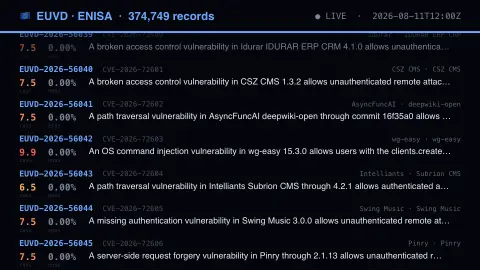
Press ESC to leave fullscreen. Settings are saved in your browser only.
How the Europe's Own Vulnerability Register screensaver works
The saver reads the source described above and draws it on a canvas — no account, no tracking.
ENISA's EU Vulnerability Database, gathered key-less by the pipeline. It issues its own ids alongside the CVE aliases and ships an EPSS score with each: CVSS says how bad a flaw would be, EPSS says how likely anyone is to bother exploiting it.
It refreshes on a schedule, so what you see stays current.
Colours and any options can be changed in settings; nothing is stored beyond your own browser.
Why CVSS and EPSS tell different stories
The EU Vulnerability Database (EUVD) is run by ENISA, the European Union Agency for Cybersecurity, and was launched in May 2025 to support the NIS2 Directive. It gives each vulnerability its own identifier in the form EUVD-year-number, such as EUVD-2025-14349, and cross-references a CVE identifier where one exists, so one flaw can be found under either name. It complements the CVE programme rather than replacing it.
Two scores are commonly attached to vulnerabilities, and they answer different questions. CVSS, on a scale from 0 to 10, describes the technical severity of a flaw: how it can be reached, what access it needs and what it could do. EPSS, the Exploit Prediction Scoring System maintained by FIRST, is a machine-learning model that estimates the probability, between 0 and 1, that a published CVE will be exploited in the wild in the next 30 days. A severe flaw with a low EPSS and a modest one with a high EPSS are both possible.
A vulnerability listed here is a disclosure, not evidence of an attack or of a breach. EPSS scores are published daily and so keep changing, which means a score is a snapshot of an estimate, not a fixed property of the flaw.
A worked example
ENISA's EU Vulnerability Database, gathered key-less by the pipeline. It issues its own ids alongside the CVE aliases and ships an EPSS score with each: CVSS says how bad a flaw would be, EPSS says how likely anyone is to bother exploiting it.
Settings & tips
- Accent and Background recolour the display.
- Every value on screen comes from the live source — nothing is simulated.
- Press ESC to leave fullscreen.
Frequently asked questions
- Is this real data?
- Yes — it comes from the source named on this page and is refreshed on a schedule.
- Is a key needed?
- No. This source is fully key-less.
- Is it free?
- Yes, and it runs entirely in your browser.
- What does the EPSS number mean?
- It is a probability from 0 to 1, produced by a statistical model, that a published CVE will be exploited in the wild in the next 30 days. It is recalculated daily.
- Is an EUVD id the same as a CVE?
- No. The EUVD assigns its own identifier and cross-references the CVE id where one exists, so a record can be found under either name.