What Drugs Actually Bind To Screensaver
The What Drugs Actually Bind To screensaver shows curated drug targets from the IUPHAR/BPS Guide to Pharmacology, gathered by the pipeline. No CORS header, and target names carry HTML subscript markup that has to be stripped before it can be drawn on a canvas. It's free, runs in your browser, and ESC exits.
Live preview
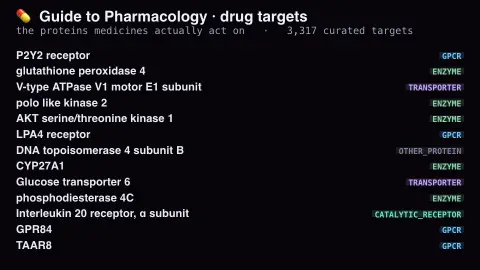
Press ESC to leave fullscreen. Settings are saved in your browser only.
How the What Drugs Actually Bind To screensaver works
The saver reads the source described above and draws it on a canvas — no account, no tracking.
Curated drug targets from the IUPHAR/BPS Guide to Pharmacology, gathered by the pipeline. No CORS header, and target names carry HTML subscript markup that has to be stripped before it can be drawn on a canvas.
It refreshes on a schedule, so what you see stays current.
Colours and any options can be changed in settings; nothing is stored beyond your own browser.
About the Guide to Pharmacology
The IUPHAR/BPS Guide to Pharmacology is an expert-curated database of pharmacological data, developed at the University of Edinburgh with the International Union of Basic and Clinical Pharmacology (IUPHAR) and the British Pharmacological Society (BPS) as partner organisations. Its subject is the target: the protein a medicine or experimental compound acts on, whether that is a receptor, an enzyme, a channel or a transporter.
The Guide organises its targets into classes that include G protein-coupled receptors, ion channels, nuclear hormone receptors, kinases, catalytic receptors, transporters and enzymes. Its content is drawn largely from the pharmacological and medicinal chemistry literature and is curated and peer-reviewed, rather than scraped, so it covers a deliberately selected set of targets, not every protein in the genome.
Any entry is the start of a story: the same receptor may be the target of several approved drugs, a laboratory tool compound, or nothing yet. A listing here shows that a protein is of pharmacological interest, not that a safe or effective drug for it exists.
A worked example
Curated drug targets from the IUPHAR/BPS Guide to Pharmacology, gathered by the pipeline. No CORS header, and target names carry HTML subscript markup that has to be stripped before it can be drawn on a canvas.
Settings & tips
- Accent and Background recolour the display.
- Every value on screen comes from the live source — nothing is simulated.
- Press ESC to leave fullscreen.
Frequently asked questions
- Is this real data?
- Yes — it comes from the source named on this page and is refreshed on a schedule.
- Is a key needed?
- No. This source is fully key-less.
- Is it free?
- Yes, and it runs entirely in your browser.
- What does the target type mean?
- It is the broad class of protein, such as enzyme, transporter or ion channel. The class reflects how the protein works and which kinds of molecules usually bind it.
- Who maintains the Guide to Pharmacology?
- It is developed at the University of Edinburgh, with IUPHAR and the British Pharmacological Society as partner organisations.
- Are all of these drug targets for approved medicines?
- No. The Guide includes targets of approved drugs as well as targets studied with investigational compounds and research tools, so inclusion is not an endorsement of a treatment.