Who Registered This Screensaver
The Who Registered This screensaver shows RDAP registration records for well-known domains, read live and key-less. It’s free, runs in your browser, and ESC exits.
Live preview
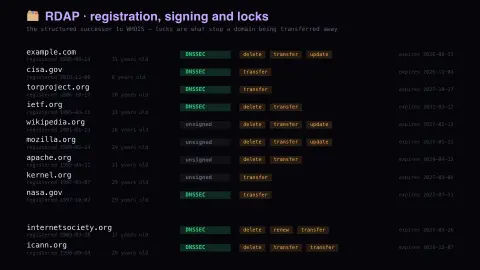
Press ESC to leave fullscreen. Settings are saved in your browser only.
How the Who Registered This screensaver works
The saver reads the source described above and draws it on a canvas — no account, no tracking.
RDAP registration records for well-known domains, read live and key-less. The structured successor to WHOIS. The transfer locks are the part worth watching: an unlocked domain can be moved out from under its owner with far less friction.
It refreshes on a schedule, so what you see stays current.
Colours and any options can be changed in settings; nothing is stored beyond your own browser.
From WHOIS to RDAP
RDAP, the Registration Data Access Protocol, was standardised by the IETF in 2015 (RFC 7480 onward) as the successor to WHOIS. WHOIS returned free-form text whose layout varied by registry; RDAP returns machine-readable JSON over a web interface. IANA publishes a bootstrap registry as JSON that maps each top-level domain to the RDAP server that answers for it, which makes it far easier for software to read.
A domain record lists the registrar, dated events such as registration, expiration and last change, name servers, and status values. The status values come from the EPP standard that registries use, and RFC 8056 defines how they map into RDAP. Codes such as clientTransferProhibited and serverTransferProhibited mean transfers to another registrar are blocked, while clientDeleteProhibited blocks deletion.
Since the GDPR took effect in May 2018, ICANN’s temporary specification has required registrant contact details to be redacted unless the contact opts in to publication, with registrars offering an anonymised email address or web form instead. The display shows what a registry published, not who currently controls the site.
A worked example
RDAP registration records for well-known domains, read live and key-less. The structured successor to WHOIS. The transfer locks are the part worth watching: an unlocked domain can be moved out from under its owner with far less friction.
Settings & tips
- Accent and Background recolour the display.
- Every value on screen comes from the live source — nothing is simulated.
- Press ESC to leave fullscreen.
Frequently asked questions
- Is this real data?
- Yes — it comes from the source named on this page and is refreshed on a schedule.
- Is a key needed?
- No. This source is fully key-less.
- Is it free?
- Yes, and it runs entirely in your browser.
- Why are owner names hidden?
- Since the GDPR took effect in 2018, ICANN rules have required registrars to redact contact details unless the contact opts in to publication. Public RDAP responses therefore often show only the registrar and technical fields.
- Does a transfer lock make a domain secure?
- It makes unauthorised transfers harder but is one layer among several. Account security at the registrar still matters, and a lock does not protect against other kinds of compromise.