Who Is Long, Who Is Short Screensaver
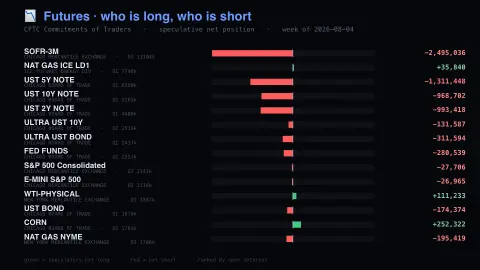
The Who Is Long, Who Is Short screensaver shows the CFTC's weekly Commitments of Traders report, key-less: how many futures contracts speculators hold long against short in each market. It's free, runs in your browser, and ESC exits.
Live preview
Press ESC to leave fullscreen. Settings are saved in your browser only.
How the Who Is Long, Who Is Short screensaver works
The saver reads the source described above and draws it on a canvas — no account, no tracking.
The CFTC's weekly Commitments of Traders report, key-less: how many futures contracts speculators hold long against short in each market. Ranked by open interest, because sorting purely by date surfaces obscure crack spreads instead of the markets anyone follows.
It refreshes on a schedule, so what you see stays current.
Colours and any options can be changed in settings; nothing is stored beyond your own browser.
How the Commitments of Traders report works
The Commodity Futures Trading Commission is the US regulator of futures markets, and every week it publishes the Commitments of Traders report. It breaks down open interest in futures and options on futures as of Tuesday’s close, and the report is generally released the following Friday at 3:30 p.m. Eastern. The CFTC receives firm data on Wednesday morning and verifies it by Friday afternoon, so what you see is always a few days old. A market appears only if 20 or more traders hold positions at or above the CFTC’s reporting levels.
The report comes in several formats. The legacy format splits positions into commercial and non-commercial traders, the latter often called speculators. The disaggregated format separates producers, swap dealers, managed money and others. Each category shows long and short contract counts, and net position is simply longs minus shorts. Open interest is the total number of outstanding contracts, which is why markets are ranked by it.
A net long position is not a prediction: every futures contract has a buyer and a seller, so one side’s long is always matched by another’s short, and a hedger’s position may offset exposure in the physical market. The report covers only traders large enough to be reported, in aggregated categories. It is descriptive market data, not a trading signal or advice.
A worked example
The CFTC's weekly Commitments of Traders report, key-less: how many futures contracts speculators hold long against short in each market. Ranked by open interest, because sorting purely by date surfaces obscure crack spreads instead of the markets anyone follows.
Settings & tips
- Accent and Background recolour the display.
- Every value on screen comes from the live source — nothing is simulated.
- Press ESC to leave fullscreen.
Frequently asked questions
- Is this real data?
- Yes — it comes from the source named on this page and is refreshed on a schedule.
- Is a key needed?
- No. This source is fully key-less.
- Is it free?
- Yes — free, no download, in your browser.
- Why is the data always a few days old?
- Positions are measured as of Tuesday’s close and published on Friday, after the CFTC has received the data on Wednesday and verified it.
- Who counts as a speculator in the report?
- In the legacy report it is the non-commercial group, traders that are not using futures to hedge a commercial business. Newer reports use more specific categories such as managed money.